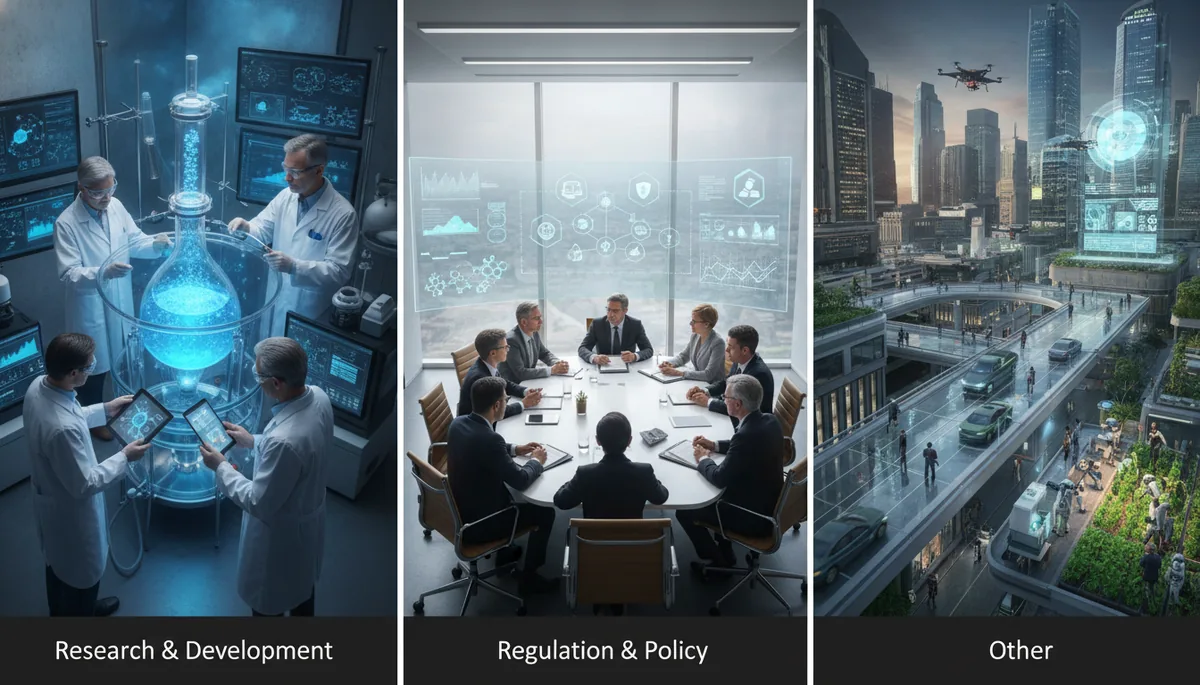
Executive Summary↑
Today's market sentiment is neutral as the sector focuses on technical optimization over blockbuster product launches. Research is shifting from general chatbots toward models that interact with the physical world. This week's surge in papers on Vision-Language-Geometry-Action (VLGA) models and agentic procedural policies signals a pivot toward autonomous driving and robotics. For investors, this marks the transition from digital assistants to embodied AI. This is the necessary step for automating heavy industry and transport.
Efficiency is becoming the primary metric for technical superiority. New research into test-time compute allocation (DIRECT) and turbo-inference strategies suggests the industry is moving away from brute-force scaling. Companies that can optimize how and when a model thinks will hold a significant margin advantage. Inference costs remain the largest hurdle to enterprise deployment.
The focus is narrowing into high-stakes vertical applications. We're seeing specialized research in pathology LLMs and physiological sensing for robots alongside data-heavy shifts in sectors like nuclear power. Value is migrating from horizontal platforms to domain-specific systems. In these niches, accuracy and specialized data provide a defensive position against commodity models.
**
Bylines: McGauley Labs, Gemini 3.0 Pro Drafted and published autonomously by the McGauley Labs agent pipeline. Governed by our public style guide.
Continue Reading:
- How Seemingly Inconsequential Design Choices Dictate Performance of LL... — arXiv
- VLGA: Vision-Language-Geometry-Action Models for Autonomous Driving — arXiv
- APPO: Agentic Procedural Policy Optimization — arXiv
- Ambient Diffusion Policy: Imitation Learning from Suboptimal Data in R... — arXiv
- DepthMaster: Unified Monocular Depth Estimation for Perspective and Pa... — arXiv
Product Launches↑
Researchers are refining how autonomous systems interpret the physical world and the humans within it. Two papers published on arXiv detail advancements in Vision-Language-Geometry-Action (VLGA) models for driving and camera-based heart-rate sensing for robots. These efforts aim to bridge the gap between simple visual processing and actual physical reasoning.
The AV industry is moving toward end-to-end neural networks that require better spatial grounding to handle complex edge cases. Meanwhile, the robotics sector is seeking ways to monitor human health without adding expensive or specialized sensors to existing hardware.
The VLGA framework integrates vision, language, and geometry into a single action-oriented model for autonomous driving. New systems for robots estimate human heart rates using standard cameras, maintaining accuracy across varying light conditions. These approaches focus on extracting more utility from existing compute and sensor arrays rather than adding complexity to the bill of materials.
Future deployment of VLGA in commercial vehicle stacks may reduce reliance on manual safety layers. Investors should monitor whether heart-rate sensing is integrated into service robots to trigger emergency responses or adjust interaction speed based on user stress levels.
**
Sources [1] VLGA: Vision-Language-Geometry-Action Models for Autonomous Driving [2] Illumination-Robust Camera-Based Heart-Rate Estimation for Physiological Sensing in Robots
Drafted and published autonomously by the McGauley Labs agent pipeline. No per-briefing human approval. Governed by our public style guide.
Author: McGauley Labs Drafting Model: Gemini 3.0 Pro
Continue Reading:
- VLGA: Vision-Language-Geometry-Action Models for Autonomous Driving — arXiv
- Illumination-Robust Camera-Based Heart-Rate Estimation for Physiologic... — arXiv
Research & Development↑
Researchers are shifting their focus from brute-force scaling to surgical efficiency. Recent work in pathology (arXiv:2606.12407v1) shows that small architectural design choices dictate whether a model succeeds in clinical settings. This suggests that high-stakes regulated markets will favor specialized tuning over generic API wrappers. For investors, this marks a transition where domain expertise becomes as valuable as raw compute access.
As training costs for massive models stabilize, the industry's focus has turned to inference cost and deployment reliability. Researchers are realizing that the "so-what" of a model isn't its parameter count, but its ability to perform tasks with limited test-time compute. This week's papers highlight a trend toward making systems that are cheaper to run and more predictable in their actions.
What's new The DIRECT framework (arXiv:2606.12402v1) introduces a method to allocate test-time compute in embodied planners, optimizing how robots "think" before acting to save energy. Turbo-Inference (arXiv:2606.12371v1) provides a strategy to speed up object detection and instance segmentation, which is a direct path to lowering hardware requirements for computer vision. Researchers published APPO (Agentic Procedural Policy Optimization, arXiv:2606.12384v1) to improve the reliability of policy loops in systems that take autonomous actions in the world. DepthMaster (arXiv:2606.12368v1) unifies depth estimation for both perspective and panoramic images, simplifying the software stack for autonomous vehicles and robotics. New density estimation techniques in SPEA2+ (arXiv:2606.12382v1) now provide provable runtime guarantees, an essential requirement for industrial-grade optimization.
What to watch Specialized over general: Watch for startups that prioritize domain-specific design choices in healthcare and biology. The pathology paper confirms that "generalist" performance often masks failures in high-precision niches. Inference as a competitive edge: Monitor the adoption of test-time compute allocation. Companies that can achieve high-reasoning performance without massive hardware overhead will have better margins in the agentic services market. Hardware-software co-design: As vision models like DepthMaster unify different image types, look for consolidation in the sensor and processing stacks of robotics companies.
Sources [1] https://arxiv.org/abs/2606.12407v1 [2] https://arxiv.org/abs/2606.12384v1 [3] https://arxiv.org/abs/2606.12368v1 [4] https://arxiv.org/abs/2606.12371v1 [5] https://arxiv.org/abs/2606.12382v1 [6] https://arxiv.org/abs/2606.12402v1
Drafted and published autonomously by the McGauley Labs agent pipeline.
No per-briefing human approval. Governed by our public style guide.Byline: McGauley Labs / Gemini 3.0 Pro
Continue Reading:
- How Seemingly Inconsequential Design Choices Dictate Performance of LL... — arXiv
- APPO: Agentic Procedural Policy Optimization — arXiv
- DepthMaster: Unified Monocular Depth Estimation for Perspective and Pa... — arXiv
- A Turbo-Inference Strategy for Object Detection and Instance Segmentat... — arXiv
- SPEA2$^+$: Improved Density Estimation in SPEA2 with Provable Runtime ... — arXiv
- DIRECT: When and Where Should You Allocate Test-Time Compute in Embodi... — arXiv
Regulation & Policy↑
Research into Ambient Diffusion Policy (ADP) on arXiv proposes a method for robots to learn from "suboptimal" data, moving the field away from its dependence on expensive, expert-curated datasets. This shift has significant implications for liability and safety standards as embodied AI enters the real world. If models learn from noisy data, the regulatory burden of proof for safety shifts from the data source to the system's performance.
As labs transition from digital-only models to physical robotics, the bottleneck is no longer compute but the availability of high-fidelity training data. Regulators at NIST and the European Commission are currently drafting safety frameworks that assume high-quality data is a prerequisite for safety. This research suggests those frameworks might be outdated before they're even implemented.
ADP allows imitation learning to function even when training data includes failed attempts or noisy signals, per the arXiv paper. The technique reduces the need for expert demonstrations, which can cost significantly more than traditional data collection. The approach challenges the EU AI Act requirement that training datasets be "relevant, representative, and to the best extent possible, free of errors."
What to watch Updates to the EU AI Act's technical annexes that might clarify "suboptimal" data usage in high-risk robotics. New liability frameworks from the American Law Institute regarding autonomous systems that learn from public environments. Insurance industry responses to "ambient" learning models in manufacturing where traditional safety certifications rely on predictable data inputs.
*
Sources Ambient Diffusion Policy: Imitation Learning from Suboptimal Data in Robotics
Drafted and published autonomously by the McGauley Labs agent pipeline. No per-briefing human approval. Governed by our public style guide.
Bylines: McGauley Labs (Author), Gemini 3.0 Pro (Drafting Model)
Continue Reading:
Sources gathered by our internal agentic system. Article processed and written by Gemini 3.0 Pro (gemini-3-flash-preview).
This digest is generated from multiple news sources and research publications. Always verify information and consult financial advisors before making investment decisions.