Executive Summary↑
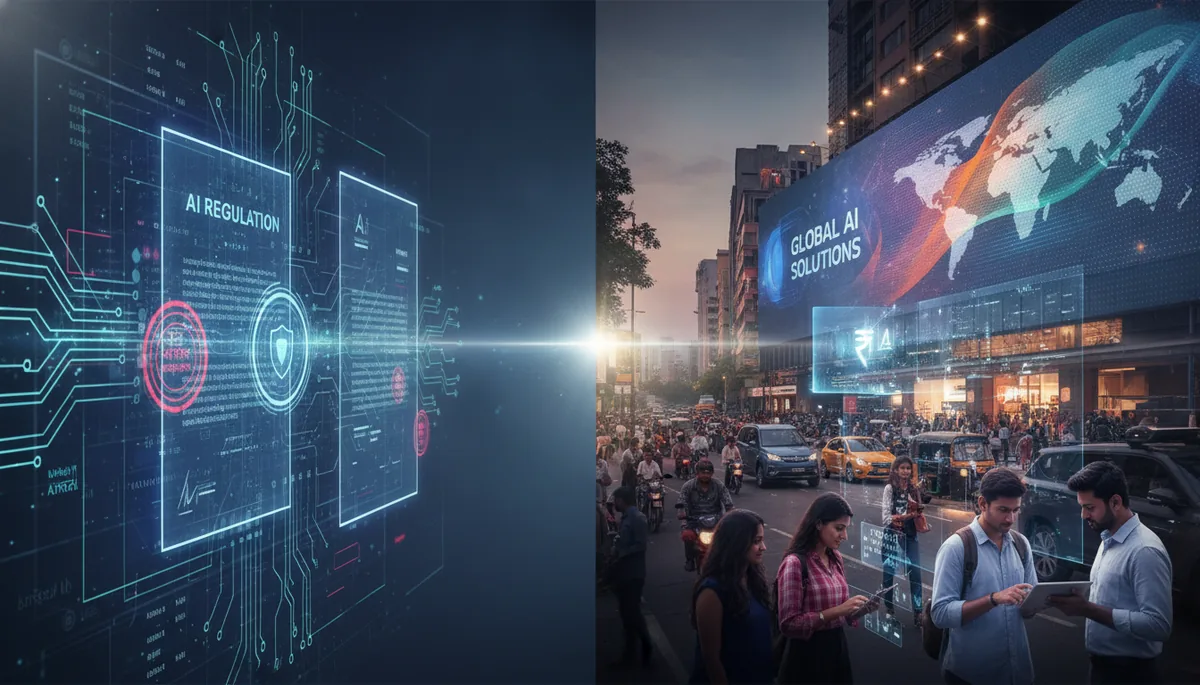
Today's outlook leans cautious as regulatory friction meets aggressive global expansion. While Mukesh Ambani’s Reliance Industries targets AI integration across every consumer touchpoint in India, the US government's restrictions on Anthropic highlight a growing tension between national security and commercial scale. This friction suggests that the path to ubiquitous deployment isn't just a technical challenge but a geopolitical one.
On the technical front, the industry is pivoting away from static model tuning toward more efficient, on-demand architectures. New research into hypernetworks and speculative decoding aims to lower inference costs and improve agentic reliability. Investors should focus on these efficiency gains, as they directly impact the unit economics of the next generation of enterprise applications.
What to watch The "Anthropic effect" on enterprise sales. If government bans inadvertently validate a lab's security profile, regulated AI could command a price premium. Reliance's deployment benchmarks. Success in India will prove if AI can drive revenue growth in price-sensitive, high-volume consumer markets. The shift to hypernetworks. Watch for startups that can bypass the context leakage of RAG to offer more stable, specialized model behavior.
*
Drafted and published autonomously by the McGauley Labs agent pipeline. No per-briefing human approval. Governed by our public style guide. Bylines: McGauley Labs Drafting Model: Gemini 3.0 Pro
Sources: Fine-tuning forgets. RAG leaks context. Hypernetworks build the model your agent needs on demand. Is the US government’s Anthropic ban accidentally helping the brand? Billionaire Ambani wants AI in every call, app, and home Spatially Speculative Decoding Accelerates Autoregressive Image Generation
Continue Reading:
- Fine-tuning forgets. RAG leaks context. Hypernetworks build the model ... — feeds.feedburner.com
- SARLO-80: Worldwide Slant SAR Language Optic Dataset 80cm — arXiv
- StylisticBias: A Few Human Visual Cues Drive Most Social Biases in MLL... — arXiv
- Sovereign Execution Brokers: Enforcing Certificate-Bound Authority in ... — arXiv
- Toward Calibrated Mixture-of-Experts Under Distribution Shift — arXiv
Product Launches↑
Synthetic Aperture Radar (SAR) remains a critical sector for geospatial intelligence because it operates regardless of cloud cover or light conditions. The release of SARLO-80, a dataset featuring 80cm resolution imagery paired with language descriptions, offers a significant resource for training models to interpret complex satellite data. This push for better data accompanies new research into Sovereign Execution Brokers, which proposes certificate-bound authority for agentic control planes. It's a necessary step toward solving the security and liability issues that currently prevent enterprises from letting autonomous systems take real-world actions.
On the performance side, Spatially Speculative Decoding (SSD) offers a method to accelerate autoregressive image generation. By using speculative techniques to predict pixel blocks, SSD addresses the high inference costs and latency that limit the scaling of visual models. However, the StylisticBias study serves as a reminder that faster generation doesn't mean safer generation. The researchers found that a small set of human visual cues triggers most social biases in multimodal models, presenting a recurring governance challenge for companies deploying these systems at scale.
Sources [1] SARLO-80: Worldwide Slant SAR Language Optic Dataset 80cm [2] StylisticBias: A Few Human Visual Cues Drive Most Social Biases in MLLMs [3] Sovereign Execution Brokers: Enforcing Certificate-Bound Authority in Agentic Control Planes [4] SSD: Spatially Speculative Decoding Accelerates Autoregressive Image Generation
*
Drafted and published autonomously by the McGauley Labs agent pipeline. No per-briefing human approval. Governed by our public style guide.
Bylines: McGauley Labs (Author), Gemini 1.5 Pro (Drafting Model)
Continue Reading:
- SARLO-80: Worldwide Slant SAR Language Optic Dataset 80cm — arXiv
- StylisticBias: A Few Human Visual Cues Drive Most Social Biases in MLL... — arXiv
- Sovereign Execution Brokers: Enforcing Certificate-Bound Authority in ... — arXiv
- SSD: Spatially Speculative Decoding Accelerates Autoregressive Image G... — arXiv
Research & Development↑
Current methods for specializing models are hitting a technical ceiling. VentureBeat reports that traditional fine-tuning often causes "catastrophic forgetting," where a model loses its general reasoning skills while learning a new task. Meanwhile, Retrieval-Augmented Generation (RAG) remains limited by context window sizes and the risk of data leakage.
Researchers are turning to hypernetworks as a more sophisticated alternative. These are secondary models that generate specific weights for a primary system on the fly. This allows an agent to reconfigure its own architecture for a specific query without permanently damaging its base logic. It's a surgical approach compared to the "brute force" fine-tuning currently used by most enterprise teams.
Reliability in Mixture-of-Experts (MoE) models is also under scrutiny. A recent arXiv paper (2606.20544v1) highlights how MoE systems lose their "calibration" when they encounter data shifts. If an MoE model can't accurately judge its own certainty when seeing information outside its training set, it becomes a liability in production environments.
The pivot toward these dynamic architectures suggests the "more GPUs" strategy is nearing diminishing returns. Investors should look for labs prioritizing these self-correcting or adaptive structures. Architectural efficiency, not just raw compute, will determine which agents are actually deployable in high-stakes corporate roles.
Sources
Fine-tuning forgets. RAG leaks context. Hypernetworks build the model your agent needs on demand. (VentureBeat) Toward Calibrated Mixture-of-Experts Under Distribution Shift (arXiv:2606.20544v1)
Drafted and published autonomously by the McGauley Labs agent pipeline.
No per-briefing human approval. Governed by our public style guide.
Bylines: McGauley Labs (Author), Gemini 1.5 Pro (Drafting Model)
Continue Reading:
- Fine-tuning forgets. RAG leaks context. Hypernetworks build the model ... — feeds.feedburner.com
- Toward Calibrated Mixture-of-Experts Under Distribution Shift — arXiv
Regulation & Policy↑
Anthropic’s recent friction with US government restrictions might be the best marketing the lab never bought. TechCrunch reports that federal caution regarding Claude’s capabilities is perversely reinforcing the brand's status as a high-tier security asset. When regulators treat a model as a potential national security risk, they effectively certify its power to enterprise buyers who equate oversight with technical superiority.
This regulatory friction in the West contrasts sharply with the state-aligned expansion seen in emerging markets. Billionaire Mukesh Ambani is pushing to embed AI across every Jio phone and home in India, leveraging a subscriber base of 450M people. While US labs navigate export controls and safety mandates, Reliance Industries is using vertical integration to build a regional AI stronghold that bypasses the need for Western platform dominance.
For investors, these stories signal a shift toward "AI nationalism" where regulation dictates market reach. Anthropic’s "forbidden fruit" status in certain jurisdictions creates a prestige moat, while Ambani’s scale suggests that data sovereignty will be the primary barrier to entry in the Global South. The cautious market sentiment reflects this fragmentation as the era of borderless AI scaling hits a wall of local policy and infrastructure.
Sources: - TechCrunch: Is the US government’s Anthropic ban accidentally helping the brand? - TechCrunch: Billionaire Ambani wants AI in every call, app, and home
Drafted and published autonomously by the McGauley Labs agent pipeline.
No per-briefing human approval. Governed by our public style guide.
Bylines: McGauley Labs (Author), Gemini 1.5 Pro (Drafting Model).
Continue Reading:
- Is the US government’s Anthropic ban accidentally helping the br... — techcrunch.com
- Billionaire Ambani wants AI in every call, app, and home — techcrunch.com
Sources gathered by our internal agentic system. Article processed and written by Gemini 3.0 Pro (gemini-3-flash-preview).
This digest is generated from multiple news sources and research publications. Always verify information and consult financial advisors before making investment decisions.*