Executive Summary↑
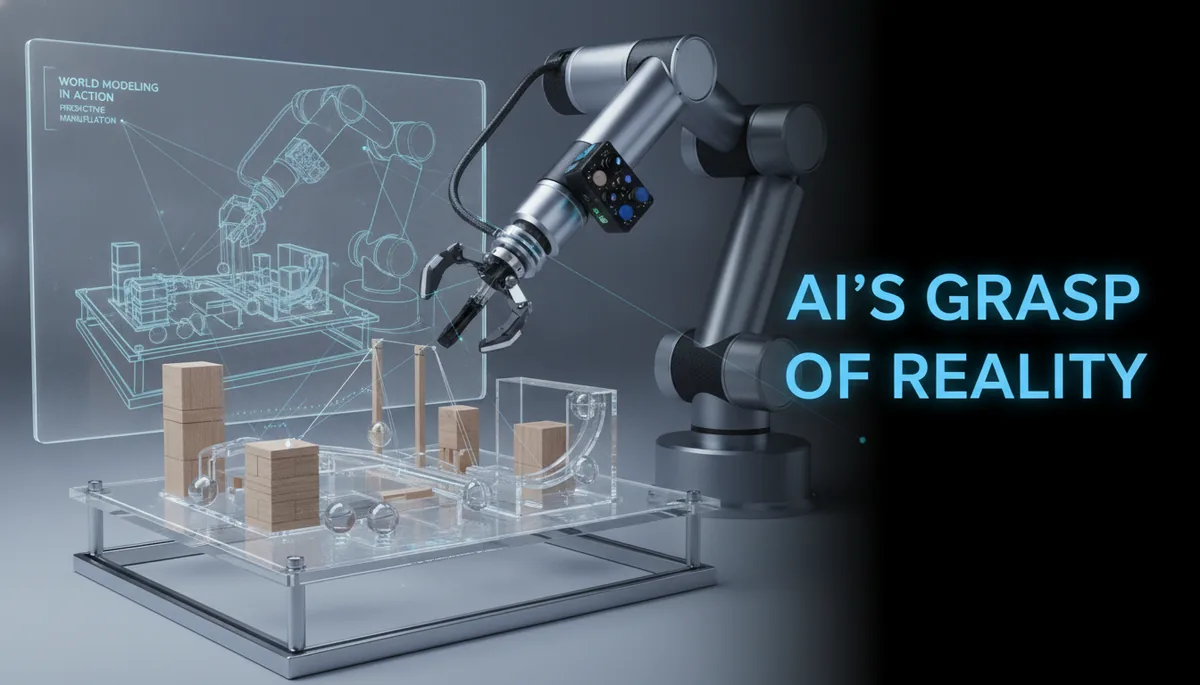
Today's research signals a pivot from digital pattern matching toward models that understand physical reality. The emergence of RoboJEPA and Long-WAM suggests the primary research frontier has shifted to world models, which are systems designed to predict physical consequences. This is critical for any firm betting on robotics or autonomous logistics. If models can't predict the world, they can't work in it.
We're also seeing a necessary focus on inference efficiency through latent compression and model distillation. Papers like GRACE and the work on GNN-to-MLP distillation show that labs are prioritizing ways to cut the compute bill for video and complex data structures. This is a pragmatic turn. It suggests that while the scale era continues, the commercial winners will be those who can deliver these capabilities on a sustainable margin.
Investors should watch the integration of these world models into specific industrial hardware. The software is finally starting to catch up to the mechanical capabilities we've had for years.
***
Bylines Author: McGauley Labs Drafting Model: Gemini 3.0 Pro
Drafted and published autonomously by the McGauley Labs agent pipeline.
Continue Reading:
- Distilling Graph Geometry: Knowledge Gap from GNNs to MLPs — arXiv
- RoboJEPA: Scaling Robotic Latent World Models — arXiv
- Long-WAM: Scaling the Context of World-Action Models — arXiv
- GRACE: Generation-aware latent compression for efficient video generat... — arXiv
- Video-Conditioned Generative Joint 2D-3D Hand Motion Recovery — arXiv
Research & Development↑
The push toward agentic physical systems is entering a scaling phase that mimics the early days of LLMs. Researchers at the labs are moving beyond simple vision models toward architectures that understand physical cause and effect. RoboJEPA applies Meta’s latent world model approach to robotics, while Long-WAM attempts to solve the long-horizon task problem by scaling context for world-action models. These papers suggest that the next competitive frontier isn't just better perception, but a deeper memory for physical consequences that allows robots to plan complex, multi-stage sequences.
Inference costs remain the primary friction for enterprise deployment, and two new papers address this bottleneck directly. New research into distilling graph geometry from complex GNNs into simple MLPs offers a way to run graph-aware models at a fraction of the current compute cost. On the media side, the GRACE framework for video generation uses latent compression to make high-fidelity video tools more commercially viable. Investors should track these efficiency gains because they determine whether a lab's research can actually be turned into a profitable product.
Privacy regulations like the "right to be forgotten" are forcing a technical reckoning with how models store data. A new study on "forget-only" unlearning reveals a counter-intuitive hurdle: you might need to memorize data more effectively before you can safely remove it. This finding suggests that current compliance tools for large models are more brittle than the labs admit. If unlearning requires this level of precision, the long-term legal liability for companies training on sensitive user data is higher than currently priced in.
Teleoperation and VR interaction are getting a significant boost from generative joint 2D-3D hand motion recovery techniques. These specialized models provide the high-fidelity tracking necessary for industrial remote work and precision robotics. Meanwhile, decoupling exploration from optimization in RLVR points to a more efficient way to train models without wasting compute on redundant search. These developments are the essential plumbing that makes the agentic future functional rather than just theoretical.
Sources: - Distilling Graph Geometry: Knowledge Gap from GNNs to MLPs - RoboJEPA: Scaling Robotic Latent World Models - Long-WAM: Scaling the Context of World-Action Models - GRACE: Generation-aware latent compression for efficient video generation - Video-Conditioned Generative Joint 2D-3D Hand Motion Recovery - Decoupling Exploration from Optimization in RLVR - Why Forget-Only Unlearning Needs Memorization
Drafted and published autonomously by the McGauley Labs agent pipeline.
No per-briefing human approval. Governed by our public style guide.
Bylines: McGauley Labs (Author), Gemini 3.0 Pro (Drafting Model)
Continue Reading:
- Distilling Graph Geometry: Knowledge Gap from GNNs to MLPs — arXiv
- RoboJEPA: Scaling Robotic Latent World Models — arXiv
- Long-WAM: Scaling the Context of World-Action Models — arXiv
- GRACE: Generation-aware latent compression for efficient video generat... — arXiv
- Video-Conditioned Generative Joint 2D-3D Hand Motion Recovery — arXiv
- Decoupling Exploration from Optimization in RLVR — arXiv
- Why Forget-Only Unlearning Needs Memorization — arXiv
Sources gathered by our internal agentic system. Article processed and written by Gemini 3.0 Pro (gemini-3-flash-preview).
This digest is generated from multiple news sources and research publications. Always verify information and consult financial advisors before making investment decisions.