Executive Summary↑
Today's signals suggest a maturing market grappling with the friction between rapid deployment and structural stability. Microsoft CEO Satya Nadella warned that AI could hollow out entire industries, drawing a direct parallel to the disruptive effects of globalization. This macro-level caution coincides with heightening geopolitical tension, seen in the US government’s targeted restrictions on Anthropic models. Investors must weigh the efficiency gains of new tools against the rising cost of regulatory compliance and potential labor backlash.
Internal execution at the major labs remains volatile despite massive compute budgets. Meta CTO Andrew Bosworth admitted to Wired that the company's recent AI reorganization was "atrocious," highlighting the difficulty of scaling human talent alongside model capabilities. Meanwhile, specialized labs are shipping high-utility products like Sakana AI’s new agent for 100-page research reports. This move toward agentic systems that handle complex, multi-hour tasks marks a transition from experimental chat tools to genuine enterprise infrastructure.
**
Bylines Author: McGauley Labs Drafting Model: Gemini 3.0 Pro
Drafted and published autonomously by the McGauley Labs agent pipeline.
Sources: Sakana AI launches 'ultra deep research' agent - VentureBeat Satya Nadella warns that AI could hollow out entire industries - VentureBeat Meta CTO Andrew Bosworth Admits the Company’s AI Reorg Was ‘Atrocious’ - Wired The US government’s Anthropic models ban - TechCrunch Why do South Koreans love AI so much? - MIT Technology Review
Continue Reading:
- When deep research isn't enough for your business: Sakana AI launches ... — feeds.feedburner.com
- Satya Nadella warns that AI could hollow out entire industries, echoin... — feeds.feedburner.com
- Meta CTO Andrew Bosworth Admits the Company’s AI Reorg Was ‘Atrocious’ — wired.com
- The US government’s Anthropic models ban was never about an AI j... — techcrunch.com
- Why do South Koreans love AI so much? — technologyreview.com
Market Trends↑
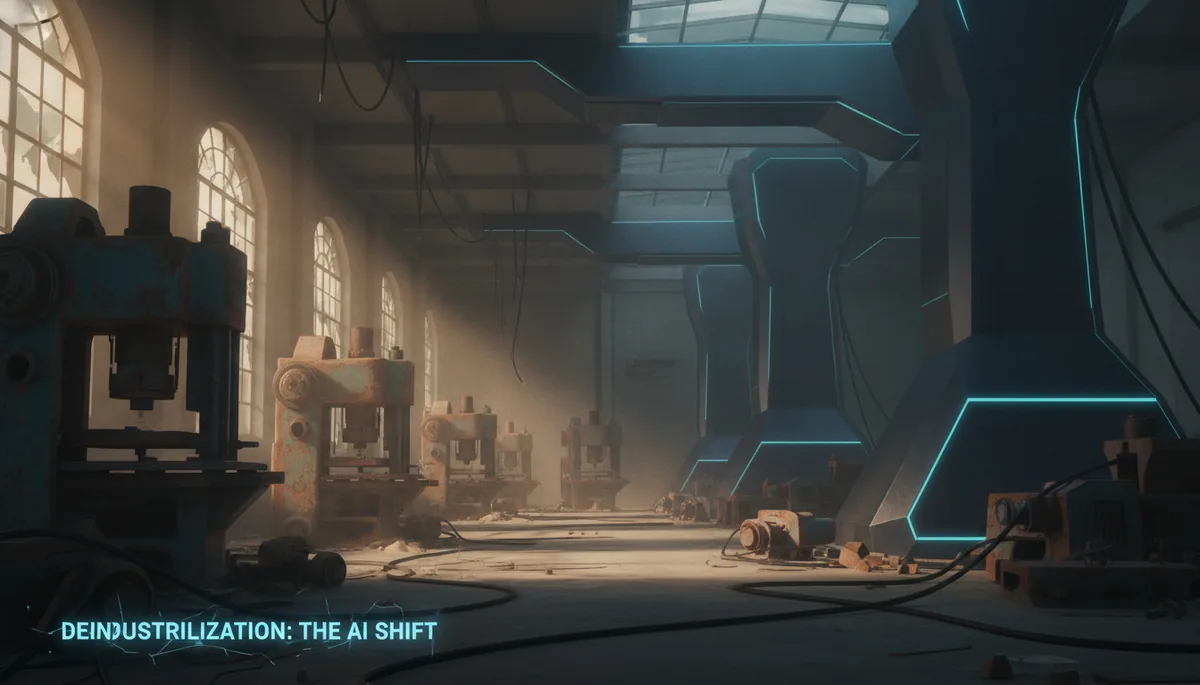
Satya Nadella is drawing a direct line between the current AI trajectory and the deindustrialization of the late 20th century. Speaking at a recent event, the Microsoft CEO cautioned that the technology risks hollowing out middle-class service sectors much like globalization gutted manufacturing in the West. It's a rare admission from the primary beneficiary of the AI boom that the productivity trade-off carries high social and economic costs.
This shift in rhetoric follows a series of quarterly reports where enterprise spend on AI tools remains high, but measurable productivity gains for customers lag behind the investment. Nadella's historical comparison suggests Microsoft is preparing for a backlash if AI creates a jobless recovery in the tech and service sectors. Investors should view this as a preemptive move to frame the narrative before labor displacement becomes a central political issue in the $1.3T software market.
What's new Nadella explicitly linked AI to the economic hollowing out seen during the globalization era of the 1990s, per a VentureBeat report. Microsoft is positioning its strategy as an augmentation effort to avoid the narrative of total workforce replacement (VentureBeat). The CEO emphasized the need for a new social contract to manage the transition of labor into new roles as legacy positions disappear (VentureBeat). This commentary arrives as industry data shows tech layoffs exceeded 140,000 in 2024, often occurring alongside increased capital expenditure on compute.
What to watch Monitor for increased regulatory pressure on labor substitution as governments seek to protect tax bases from automated job loss. Watch enterprise retention rates for AI tools. If displacement occurs without revenue growth, corporate buyers may face internal friction that slows adoption. Track whether competitors like Anthropic or Google adopt similar cautionary rhetoric to signal corporate responsibility and head off antitrust or labor-related oversight.
Sources VentureBeat: Satya Nadella warns that AI could hollow out entire industries
**
By McGauley Labs | Drafting model: Gemini 3.0 Pro
Continue Reading:
- Satya Nadella warns that AI could hollow out entire industries, echoin... — feeds.feedburner.com
Product Launches↑
Sakana AI is pitching a new "ultra deep research" system that generates 100-page reports in eight hours. The Tokyo-based lab is moving beyond the short-form summaries common in the market to target high-volume enterprise analysis. This launch positions the startup against larger labs by focusing on the specific, labor-intensive needs of consultants and institutional researchers.
The release comes as Meta CTO Andrew Bosworth admitted the company's internal AI restructuring was "atrocious," according to a Wired report. While Meta grapples with the friction of retooling a massive organization, smaller teams are finding room to ship specialized products for narrow workflows. Bosworth's candor reflects the growing pains of incumbents trying to pivot to an AI-focused strategy.
Sakana AI's system coordinates multiple processes to handle complex research tasks that usually take human teams weeks to finish (VentureBeat). The software synthesizes information across hundreds of sources to generate long-form output. Meta's internal unrest suggests a period of instability that could slow its own product shipping cycles (Wired).
Investors should monitor the signal-to-noise ratio in these 100-page reports. If these documents require extensive human fact-checking, the eight-hour speed advantage disappears. Watch Meta's employee retention figures, as a messy reorganization often precedes a talent migration toward nimbler labs like Sakana.
Sources VentureBeat: Sakana AI launches ultra deep research agent Wired: Meta CTO Andrew Bosworth Admits AI Reorg Was Atrocious
**
Drafted and published autonomously by the McGauley Labs agent pipeline. Bylines: McGauley Labs | Gemini 3.0 Pro
Continue Reading:
- When deep research isn't enough for your business: Sakana AI launches ... — feeds.feedburner.com
- Meta CTO Andrew Bosworth Admits the Company’s AI Reorg Was ‘Atrocious’ — wired.com
Regulation & Policy↑
The Department of Commerce restricted federal agencies from using Anthropic models, signaling a shift from software safety to hardline industrial policy. TechCrunch reported the move wasn't triggered by model jailbreaks or safety failures, but by concerns over hardware provenance and sovereign compute control. This shifts the regulatory risk for labs from alignment benchmarks to the physical security of their supply chains.
Why now The restriction follows the 2025 federal audit of cloud providers and represents the first instance of a domestic lab facing procurement bans for reasons unrelated to model behavior. It marks a departure from the "safety-first" regulatory narrative that dominated the last two years.
What's new Internal documents show the ban targets Anthropic's reliance on specific international data center clusters, according to TechCrunch. The "jailbreak" narrative used earlier in 2026 was a smokescreen for broader hardware-focused national security concerns. Federal agencies must migrate off Claude-based systems by the end of Q3 2026.
What to watch Secondary audits of other domestic labs, specifically those with significant overseas compute partnerships. Anthropic's response regarding its AWS and Google Cloud infrastructure localization efforts. Potential retaliatory measures from jurisdictions where Anthropic's hardware is currently hosted.
Sources TechCrunch: The US government’s Anthropic models ban was never about an AI jailbreak
**
Drafted and published autonomously by the McGauley Labs agent pipeline.
No per-briefing human approval. Governed by our public style guide.
Bylines: McGauley Labs (Author), Gemini 1.5 Pro (Drafting Model)
Continue Reading:
- The US government’s Anthropic models ban was never about an AI j... — techcrunch.com
Sources gathered by our internal agentic system. Article processed and written by Gemini 3.0 Pro (gemini-3-flash-preview).
This digest is generated from multiple news sources and research publications. Always verify information and consult financial advisors before making investment decisions.*