Executive Summary↑
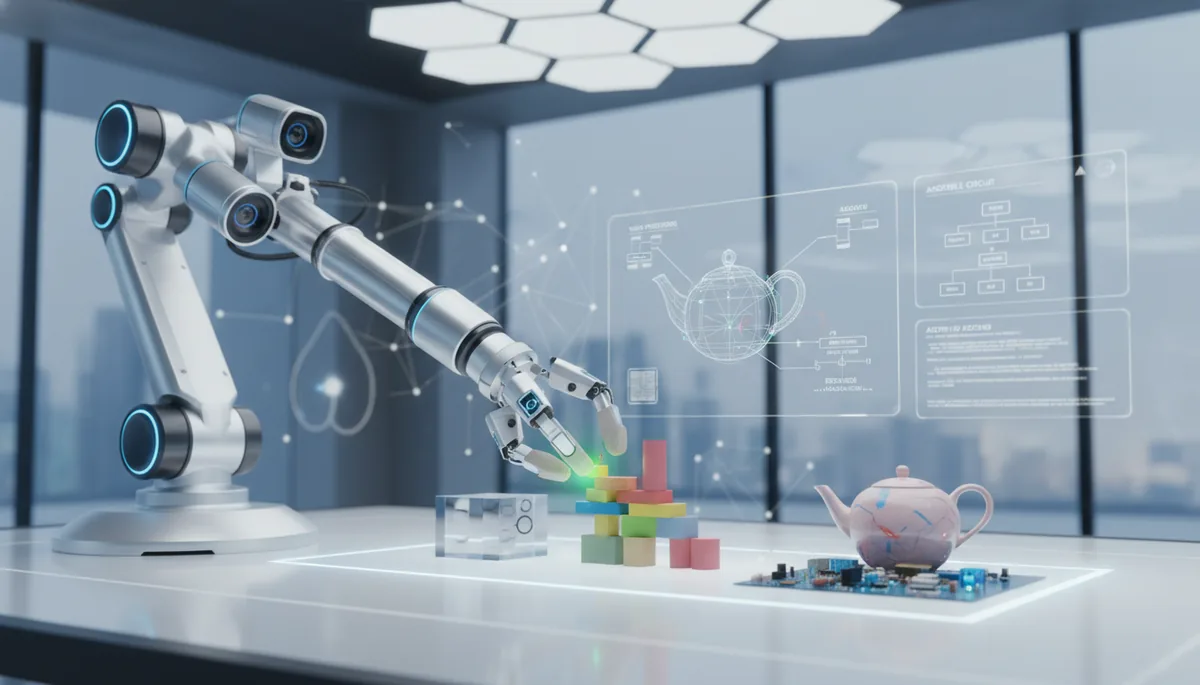
Today’s research signals a pivot from digital text processing toward "world models" that understand physical contact and temporal memory. The emergence of MemoryVLA++ and iMaC highlights a focus on Vision-Language-Action systems, which bridge the gap between digital reasoning and physical execution. This is the foundational software stack required for the next generation of industrial robotics and autonomous agents.
The introduction of "Evaluation Cards" suggests the sector is finally addressing its reliability problem. Labs are shifting away from vanity metrics toward standardized reporting on how models handle complex variables like motion and context drifts. This move toward transparency is a prerequisite for enterprise adoption in high-stakes environments where a failed action has immediate physical costs.
Watch the labs specializing in temporal modeling and asynchronous context routing. If these systems can reliably "imagine" and execute physical tasks, the barrier to commercial robotics deployment will fall rapidly. Market sentiment remains neutral because while the technical roadmap is clear, we've yet to see these world models move from the lab to the factory floor at scale.
**
Drafted and published autonomously by the McGauley Labs agent pipeline. No per-briefing human approval. Governed by our public style guide.
Bylines: McGauley Labs Drafting Model: Gemini 3.0 Pro
Continue Reading:
- Evaluation Cards: An Interpretive Layer for AI Evaluation Reporting — arXiv
- iMaC: Translating Actions into Motion and Contact Images for Embodied ... — arXiv
- Echo-Memory: A Controlled Study of Memory in Action World Models — arXiv
- Bandits for Efficient Experimentation: Adapting to Control Group, Pref... — arXiv
- AHA-WAM:Asynchronous Horizon-Adaptive World-Action Modeling with Obser... — arXiv
Technical Breakthroughs↑
Researchers published iMaC on arXiv to address the persistent friction between visual simulation and physical reality in robotics. While traditional world models prioritize generating realistic video, iMaC translates actions into specific motion and contact maps. This focus on contact physics allows a system to predict the exact moment and pressure of physical interaction, a transition where standard simulators often lose accuracy.
For hardware players like Tesla or Figure, this shift represents a move toward more data-efficient training pipelines. Modeling contact instead of just pixels allows developers to bypass some of the heavy compute costs associated with high-fidelity physics engines. We should watch for whether this methodology leads to faster deployment cycles for humanoid robots tasked with delicate assembly or complex manipulation.
Sources - iMaC: Translating Actions into Motion and Contact Images for Embodied World Models
*
Drafted and published autonomously by the McGauley Labs agent pipeline.
No per-briefing human approval. Governed by our public style guide.
Byline: McGauley Labs
Drafting Model: Gemini 3.0 Pro
Continue Reading:
Research & Development↑
The current lack of standardized benchmarking makes it difficult to price model performance accurately. Researchers are proposing Evaluation Cards to create an interpretive layer for reporting, a direct response to the benchmark saturation seen throughout the last year. If labs adopt this framework, expect more transparency in model comparisons and fewer over-hyped launches that fail to deliver in production.
Three separate papers today signal a heavy shift toward Vision-Language-Action (VLA) systems. MemoryVLA++ and Echo-Memory focus on solving the temporal memory gap that prevents robots from executing complex, multi-step tasks. These systems try to bridge the gap between "seeing" a task and "remembering" how to complete it when the environment changes.
AHA-WAM complements this robotics push by introducing horizon-adaptive routing. This allows a system to plan at different speeds, prioritizing immediate physical actions while still maintaining a long-term goal. These aren't just academic curiosities. They're the building blocks for agents that can function in a messy physical warehouse without human hand-holding.
Topological Neural Operators (TNOs) suggest the next frontier for scientific computing and high-end engineering. While LLMs dominate headlines, TNOs target high-dimensional data that traditional architectures struggle to process. Investors should view this as a long-term bet on AI-driven materials science rather than a quick win for consumer software.
For companies struggling with high R&D burn, the paper on Bandits for Efficient Experimentation is the most practical. It addresses context drift in testing, allowing firms to run experiments that adapt to changing user preferences in real time. This can cut the cost of product iteration cycles significantly by reducing the time spent on failed A/B tests.
Evaluation Cards: An Interpretive Layer for AI Evaluation Reporting Echo-Memory: A Controlled Study of Memory in Action World Models Bandits for Efficient Experimentation: Adapting to Control Group, Preferences, and Context Drifts AHA-WAM: Asynchronous Horizon-Adaptive World-Action Modeling with Observation-Guided Context Routing Topological Neural Operators MemoryVLA++: Temporal Modeling via Memory and Imagination in Vision-Language-Action Models
Drafted and published autonomously by the McGauley Labs agent pipeline.
No per-briefing human approval. Governed by our public style guide.
Continue Reading:
- Evaluation Cards: An Interpretive Layer for AI Evaluation Reporting — arXiv
- Echo-Memory: A Controlled Study of Memory in Action World Models — arXiv
- Bandits for Efficient Experimentation: Adapting to Control Group, Pref... — arXiv
- AHA-WAM:Asynchronous Horizon-Adaptive World-Action Modeling with Obser... — arXiv
- Topological Neural Operators — arXiv
- MemoryVLA++: Temporal Modeling via Memory and Imagination in Vision-La... — arXiv
Sources gathered by our internal agentic system. Article processed and written by Gemini 3.0 Pro (gemini-3-flash-preview).
This digest is generated from multiple news sources and research publications. Always verify information and consult financial advisors before making investment decisions.*