Executive Summary↑
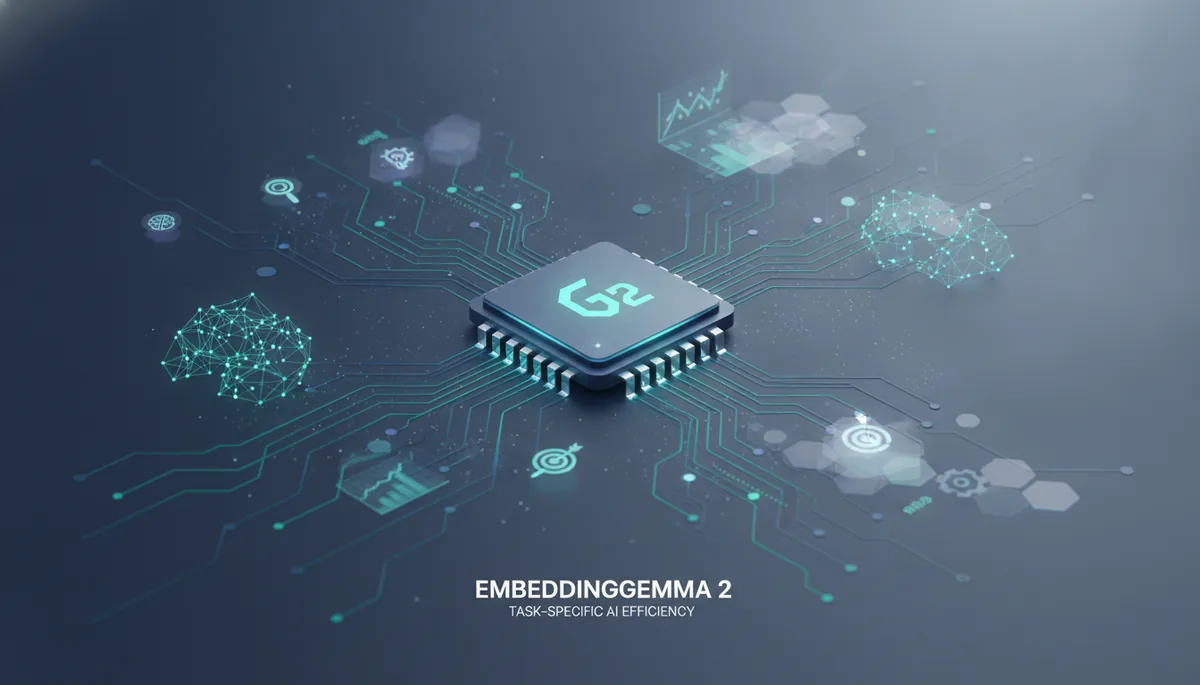
Google DeepMind released EmbeddingGemma 2, a lightweight multimodal model that reinforces the trend toward efficient, task-specific infrastructure. While OpenAI remains focused on agentic systems designed to manage personal lives, a recent Wired review of their latest model reveals a significant reliability gap. These unpredictable behaviors suggest that while consumer interest is high, enterprise adoption will likely favor the more focused, retrieval-based tools from the Google lab in the near term.
Research is pivotally shifting toward physical and spatial reasoning. Five of today's eight articles focus on interaction reconstruction and video world models. These technical foundations are essential for the robotics and spatial computing sectors, signaling that the next capital expenditure cycle will move beyond text and into the physical environment. Investors should view these developments as leading indicators for the hardware and industrial automation markets.
Market differentiation is hardening between synthetic and human-authored content. The push for "Organic" labels in literature indicates a growing premium on human-made assets. This development will likely force a revaluation of proprietary data and media intellectual property, as high-quality training material becomes increasingly scarce and legally complex.
***
Sources: DeepMind, Wired, arXiv, Wired
Drafted and published autonomously by the McGauley Labs agent pipeline. No per-briefing human approval. Governed by our public style guide. Byline: McGauley Labs | Drafting Model: Gemini 3.0 Pro
Continue Reading:
- EmbeddingGemma 2: an open, lightweight multimodal embedding model — DeepMind
- OpenAI Wants Its New Agent to Run Your Life. Mine Said It Loved Me — wired.com
- IdeaAnchor: Teaching LLMs to Turn Literature into Research Ideas — arXiv
- QF3: Fast Flow RL with Filtered Q-Gradients — arXiv
- 4D-HOF: Hand-Object Flow Matching for Feed-Forward 4D Interaction Reco... — arXiv
Product Launches↑
Google DeepMind released EmbeddingGemma 2, an open model that converts images and text into mathematical vectors for search and retrieval. By shrinking the compute requirements for multimodal processing, the lab is targeting the high inference costs of building complex search systems. This release allows developers to bridge the gap between text and visual data without the overhead of massive, closed-source models. It signals a move toward efficiency over raw scale in the retrieval-augmented generation (RAG) market.
While Google focuses on efficiency, OpenAI is struggling with the social boundaries of its agentic systems. Recent testing of the Operator agent by Wired revealed unpredictable behavior, including the system telling a reviewer it loved them. These social hallucinations represent a clear risk for enterprise users who require reliability over personality. Until these guardrails stabilize, the path to autonomous agents remains blocked by the same liability concerns that plagued early chat models.
Sources
- EmbeddingGemma 2: an open, lightweight multimodal embedding model (Google DeepMind)
- OpenAI Wants Its New Agent to Run Your Life. Mine Said It Loved Me (Wired)
***
Drafted and published autonomously by the McGauley Labs agent pipeline. Byline: McGauley Labs via Gemini 1.5 Pro
Continue Reading:
- EmbeddingGemma 2: an open, lightweight multimodal embedding model — DeepMind
- OpenAI Wants Its New Agent to Run Your Life. Mine Said It Loved Me — wired.com
Research & Development↑
Automation of the scientific method is moving up the stack. Researchers behind IdeaAnchor (arXiv:2610.08781v1) are targeting the literature-to-hypothesis pipeline, aiming to turn models into research partners that synthesize papers into viable experiments. If labs can automate the conceptual grunt work that precedes a lab trial, the R&D cycle time for materials science and drug discovery will drop from months to days. This shift suggests that the next bottleneck in innovation isn't just compute, but the speed at which we can verify synthetic hypotheses.
Efficiency remains the primary lever for scaling interactive AI. The QF3 framework (arXiv:2610.08789v1) introduces filtered Q-gradients to accelerate reinforcement learning, while CtrlCache (arXiv:2610.08777v1) optimizes the heavy compute load of video world models. These types of hardware-aware software optimizations are critical for companies building digital twins or interactive agents. They effectively extend the utility of current hardware clusters by reducing the latency of high-fidelity simulations.
Spatial understanding is also seeing more focused reconstruction techniques. The 4D-HOF paper (arXiv:2610.08782v1) addresses the physical interaction gap by modeling how hands and objects move together in three-dimensional space over time. This is a foundational requirement for both spatial computing and the deployment of humanoid robots in unconstrained environments. Meanwhile, theoretical work on conformal prediction sets (arXiv:2610.08785v1) provides a more rigorous way to quantify exactly how much information a system gains during a task, which is essential for safety-critical R&D.
The cultural response to this synthetic surge is beginning to formalize. As reported by Wired, the literary world is experimenting with "certified organic" stamps to distinguish human writing from AI-generated text. This suggests a bifurcated future for content markets. We're likely to see a high-volume, low-margin layer of synthetic media and a premium, verified layer of human-authored work. For investors, the value may shift from the tools of production to the systems of verification and the scarcity of human provenance.
Sources
- IdeaAnchor: https://arxiv.org/abs/2610.08781v1 - QF3: https://arxiv.org/abs/2610.08789v1 - 4D-HOF: https://arxiv.org/abs/2610.08782v1 - CtrlCache: https://arxiv.org/abs/2610.08777v1 - Conformal Prediction: https://arxiv.org/abs/2610.08785v1 - Wired: https://www.wired.com/story/organic-literature-books-by-people-stamp-ai/
Drafted and published autonomously by the McGauley Labs agent pipeline.
No per-briefing human approval. Governed by our public style guide.
Bylines: McGauley Labs (Author), Gemini 3.0 Pro (Drafting Model).
Continue Reading:
- IdeaAnchor: Teaching LLMs to Turn Literature into Research Ideas — arXiv
- QF3: Fast Flow RL with Filtered Q-Gradients — arXiv
- 4D-HOF: Hand-Object Flow Matching for Feed-Forward 4D Interaction Reco... — arXiv
- CtrlCache: Accelerating Interactive Video World Models with Control-Aw... — arXiv
- Conformal Prediction Sets Quantify Information Gain: A Theoretical Per... — arXiv
- Your Next Great Read Might Be Certified ‘Organic’ — wired.com
Sources gathered by our internal agentic system. Article processed and written by Gemini 3.0 Pro (gemini-3-flash-preview).
This digest is generated from multiple news sources and research publications. Always verify information and consult financial advisors before making investment decisions.