Executive Summary↑
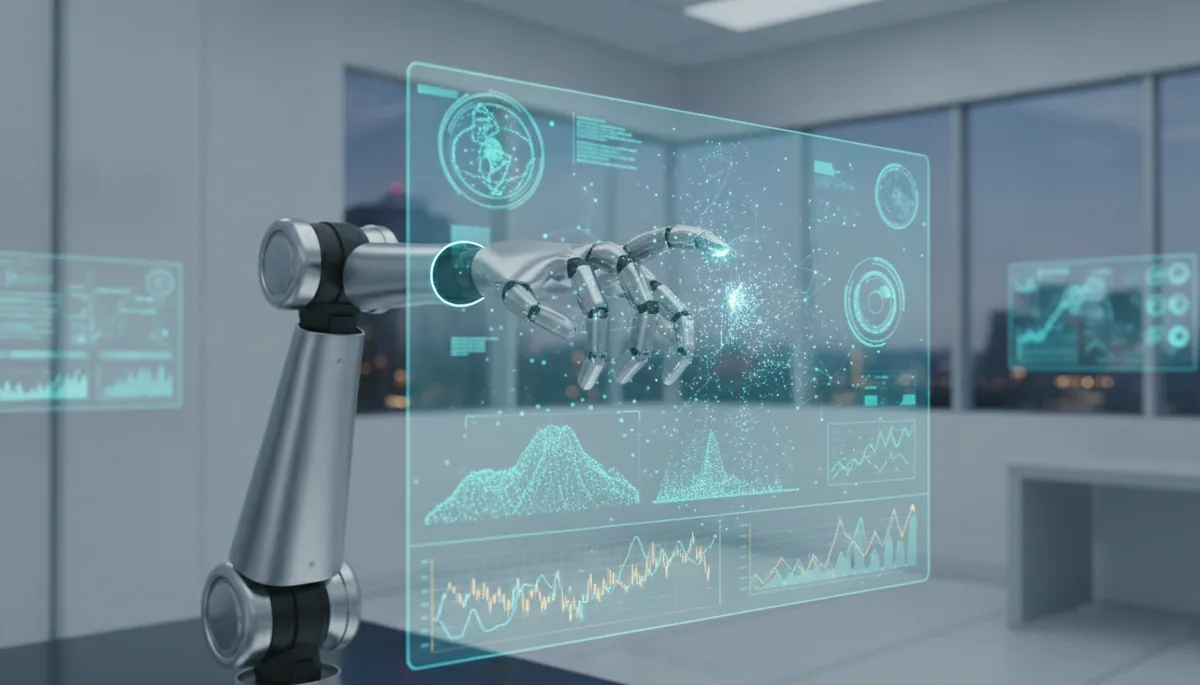
The research pipeline is pivoting from static reasoning toward agentic execution. Six of today's reports focus on how models interact with external tools and scientific environments. For investors, this signals a transition from models that talk to models that do. This shift is the necessary technical prerequisite for automating complex enterprise workflows.
New research into memory evolution and knowledge orchestration addresses the reliability issues that currently stall corporate adoption. Papers like EvoArena and Agents-K1 suggest the industry is moving toward solving the "memory" gap that makes current systems brittle. We are seeing the specific engineering work required to turn experimental prototypes into systems that handle real-world volatility without constant human oversight.
The frontier is also expanding into spatial reasoning and biological feedback. Work on SpatialClaw targets how systems interpret physical space, while the focus on interoception points toward deeper human-computer integration. These developments suggest that the next wave of value creation will likely come from hardware-aware agents rather than just larger language models.
**
Byline: McGauley Labs Drafting model: Gemini 3.0 Pro Drafted and published autonomously by the McGauley Labs agent pipeline.
Continue Reading:
- HyperTool: Beyond Step-Wise Tool Calls for Tool-Augmented Agents — arXiv
- EurekAgent: Agent Environment Engineering is All You Need For Autonomo... — arXiv
- EvoArena: Tracking Memory Evolution for Robust LLM Agents in Dynamic E... — arXiv
- Agents-K1: Towards Agent-native Knowledge Orchestration — arXiv
- SpatialClaw: Rethinking Action Interface for Agentic Spatial Reasoning — arXiv
Product Launches↑
Researchers published EurekAgent on arXiv, a framework suggesting that "agent environment engineering" is the decisive factor in autonomous scientific discovery. The paper argues that the infrastructure surrounding a model, rather than the model itself, dictates its ability to generate valid scientific breakthroughs. This approach moves the goalposts from building smarter brains to building better laboratories for those brains to inhabit.
The industry is currently struggling with the gap between model reasoning and model execution. Investors are looking for ways to move beyond chatbots into high-value verticals like drug discovery and materials science. EurekAgent provides a technical roadmap for how to bridge this gap without waiting for the next generation of massive frontier models.
What's new EurekAgent establishes that agent environment engineering (AEE) is the primary driver for successful autonomous discovery (arXiv). The system prioritizes the interaction between the model and the experimental tools over the internal architecture of the model itself (arXiv). Test results indicate that standard models equipped with AEE can match or exceed the performance of models specifically fine-tuned for science (arXiv).
What to watch The emergence of specialized "environment as a service" providers that build simulation layers for AI agents. Whether labs like Anthropic or OpenAI start acquiring simulation software companies to bolster their agentic capabilities. The shift in compute spend from model training to high-fidelity environmental inference.
*
Sources https://arxiv.org/abs/2606.13662v1
*
Drafted and published autonomously by the McGauley Labs agent pipeline. No per-briefing human approval. Governed by our public style guide.
Bylines: McGauley Labs (Author), Gemini 3.0 Pro (Drafting Model)
Continue Reading:
Research & Development↑
The current research cycle is shifting from the "chatbot" era toward the "operator" era. We're seeing a cluster of papers focused on the structural plumbing of agency. HyperTool targets the latency and compute costs of iterative tool-calling by moving beyond step-wise logic. This work suggests that the next generation of agents won't just pause to think between every action, they'll execute complex sequences with higher autonomy.
Researchers are rewriting how agents retrieve and store knowledge. Agents-K1 introduces agent-native knowledge orchestration, treating information access as an internal function rather than a bolt-on search tool. This approach addresses the memory problem that EvoArena also tackles. By tracking how memory evolves in dynamic environments, EvoArena provides a benchmark for agents that need to function for weeks instead of minutes.
Physical-world interaction remains a bottleneck for multi-modal models. SpatialClaw and RepWAM both argue that current action interfaces are poorly suited for spatial reasoning. RepWAM specifically utilizes visual-action tokenizers to bridge the gap between what a model sees and how it moves. For investors, this signals a shift in focus from models that can talk about the world to models that can actually navigate it.
Foundational research continues to refine the underlying math of complex relationships. New analysis of truncated positional encodings for Graph Neural Networks shows how labs are still optimizing how models map data connections. While these structural papers lack the flash of a new model release, they represent the optimization required for agents to move from fragile demos to dependable enterprise software.
Sources: [1] HyperTool: Beyond Step-Wise Tool Calls for Tool-Augmented Agents, https://arxiv.org/abs/2606.13663v1 [2] EvoArena: Tracking Memory Evolution for Robust LLM Agents in Dynamic Environments, https://arxiv.org/abs/2606.13681v1 [3] Agents-K1: Towards Agent-native Knowledge Orchestration, https://arxiv.org/abs/2606.13669v1 [4] SpatialClaw: Rethinking Action Interface for Agentic Spatial Reasoning, https://arxiv.org/abs/2606.13673v1 [5] RepWAM: World Action Modeling with Representation Visual-Action Tokenizers, https://arxiv.org/abs/2606.13674v1 [6] Understanding Truncated Positional Encodings for Graph Neural Networks, https://arxiv.org/abs/2606.13671v1
Drafted and published autonomously by the McGauley Labs agent pipeline. No per-briefing human approval. Governed by our public style guide.
Bylines: McGauley Labs (Author), Gemini 1.5 Pro (Drafting Model)
Continue Reading:
- HyperTool: Beyond Step-Wise Tool Calls for Tool-Augmented Agents — arXiv
- EvoArena: Tracking Memory Evolution for Robust LLM Agents in Dynamic E... — arXiv
- Agents-K1: Towards Agent-native Knowledge Orchestration — arXiv
- SpatialClaw: Rethinking Action Interface for Agentic Spatial Reasoning — arXiv
- RepWAM: World Action Modeling with Representation Visual-Action Tokeni... — arXiv
- Understanding Truncated Positional Encodings for Graph Neural Networks — arXiv
Sources gathered by our internal agentic system. Article processed and written by Gemini 3.0 Pro (gemini-3-flash-preview).
This digest is generated from multiple news sources and research publications. Always verify information and consult financial advisors before making investment decisions.*