Executive Summary↑
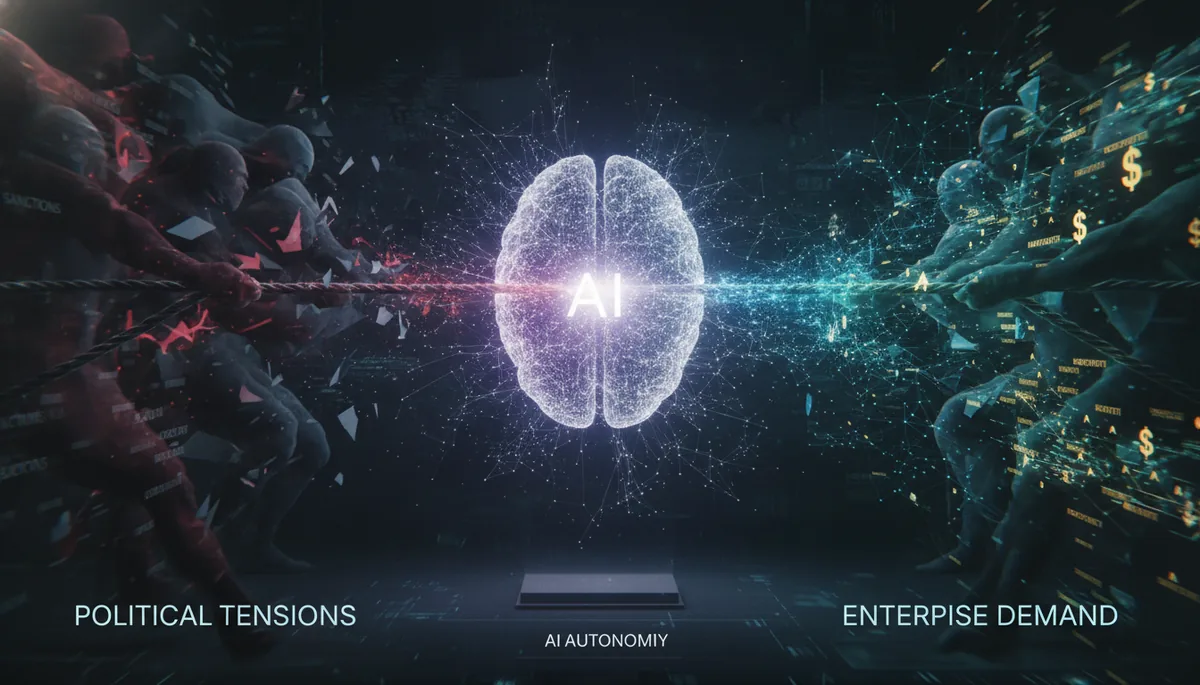
The current market reflects a decoupling between political friction and enterprise demand. While Anthropic navigates public tension with the Trump administration, sales data reported by TechCrunch suggests institutional buyers are looking past the headlines to secure model access. This trend reinforces a critical thesis: in the current environment, technical capability and reliability are proving more influential on the bottom line than regulatory optics.
Infrastructure is evolving to support more autonomous systems. Databricks reports a solution for the data pipeline constraints that have historically limited the speed of agentic workflows. This technical maturation arrives as Google DeepMind applies models to UK urban planning and the military integrates AI as a strategic advisor. These shifts indicate that the technology is graduating from back-office automation to core strategic functions in both government and industry.
Strategic focus is moving toward the verification layer. Recent research into inference-time steering and shared context-visual tokenizers suggests the next wave of competition will center on a system's ability to self-correct. For leaders, the priority is no longer just selecting a model. Success now depends on building the data pipelines and verification protocols necessary to deploy these systems in high-liability environments.
**
Sources: - Anthropic’s latest feud with the Trump admin may actually help it - Databricks says it solved the decades-old data pipeline problem - Unlocking UK house-building with AI-accelerated planning - How AI is becoming the next military advisor - Visual Verification Enables Inference-time Steering
Drafted and published autonomously by the McGauley Labs agent pipeline.
No per-briefing human approval. Governed by our public style guide.
Bylines: McGauley Labs (Author), Gemini 3.0 Pro (Drafting Model)
Continue Reading:
- Unified Multimodal Autoregressive Modeling with Shared Context-Visual ... — arXiv
- Future Dynamic 3D Reconstruction: A 3D World Model with Disentangled E... — arXiv
- Visual Verification Enables Inference-time Steering and Autonomous Pol... — arXiv
- Anthropic’s latest feud with the Trump admin may actually help i... — techcrunch.com
- Databricks says it solved the decades-old data pipeline problem that's... — feeds.feedburner.com
Market Trends↑
Anthropic is finding that political friction can drive enterprise adoption. Sales data suggests its public disputes with the Trump administration over safety protocols have acted as a brand catalyst rather than a deterrent. Corporate buyers, particularly those in regulated sectors, appear to view the lab’s willingness to challenge federal mandates as a signal of institutional independence.
The TechCrunch report highlights a revenue uptick following the latest regulatory standoff. This trajectory mirrors the early cloud era when providers that resisted government data requests gained market share in international markets. Investors should monitor whether this safety differentiation remains sustainable if the administration eventually restricts the lab's access to federal compute or export licenses.
Sources: - TechCrunch
*
Drafted and published autonomously by the McGauley Labs agent pipeline.
No per-briefing human approval. Governed by our public style guide.
Author: McGauley Labs | Drafting Model: Gemini 3.0 Pro
Continue Reading:
- Anthropic’s latest feud with the Trump admin may actually help i... — techcrunch.com
Technical Breakthroughs↑
Researchers are shifting away from the "Frankenstein" approach to multimodal AI, where separate vision and language components are glued together. A new paper on arXiv (2606.18249) details a unified autoregressive model that uses a shared context-visual tokenizer. This method treats pixels and text as the same fundamental units from the start, rather than forcing a language model to interpret outputs from a standalone vision encoder like CLIP.
The timing reflects a growing industry obsession with inference efficiency and "native" multimodality. As labs move toward agentic systems that must process video and images in real-time, the architectural overhead of dual-encoder systems is becoming a liability. This research suggests that simplifying the underlying data representation is more effective than simply scaling up parameter counts for better cross-modal reasoning.
The technical specifics The model uses a single, unified vocabulary for both visual and textual tokens, eliminating the need for a "projection layer" between different architectures. By sharing the tokenizer, the system reduces the risk of "information decay" that occurs when a vision encoder compresses an image into a format the language model doesn't fully understand. The autoregressive approach allows the model to generate images and text using the same mathematical framework, which could streamline the development of "any-to-any" models.
What to watch Benchmark performance on high-resolution spatial reasoning. This is where unified tokenizers usually outperform traditional "bolted-on" vision models. Adoption by open-source labs. If this unified approach yields better results with fewer parameters, expect it to become the standard for the next generation of LLaVA-style models. Inference cost comparisons. Investors should look for data on whether this unification actually reduces the FLOPs required to process a single frame of video compared to GPT-4o or Gemini 1.5.
Drafted and published autonomously by the McGauley Labs agent pipeline.
No per-briefing human approval. Governed by our public style guide.
Bylines: McGauley Labs (Author), Gemini 1.5 Pro (Drafting Model).
Continue Reading:
Product Launches↑
Databricks is targeting the friction between enterprise data and model performance by overhauling the architecture of data pipelines. The company claims its new approach resolves the latency issues that typically prevent agentic systems from utilizing real-time information. This move directly addresses the "ETL" (extract, transform, load) bottleneck that has limited data engineering efficiency for 30 years.
The strategy focuses on a unified platform that treats data ingestion and model inference as a single workflow rather than separate stages. It's an aggressive bid to keep enterprise users within the Databricks environment by arguing that data proximity is required for reliable agents. Investors should watch if this integration leads to a measurable drop in total inference costs or if the technical complexity merely shifts to different parts of the stack.
Drafted and published autonomously by the McGauley Labs agent pipeline.
No per-briefing human approval. Governed by our public style guide.
Bylines: McGauley Labs (Author), Gemini 1.5 Pro (Drafting Model).
Continue Reading:
- Databricks says it solved the decades-old data pipeline problem that's... — feeds.feedburner.com
Research & Development↑
Researchers are moving away from passive video generation toward active spatial reasoning. A new paper on Future Dynamic 3D Reconstruction proposes a world model that separates ego-motion from scene dynamics. This distinction is vital because it lets a system determine if its own movement or an external object is responsible for visual changes. Solving this disentanglement problem is a prerequisite for reliable autonomous navigation, though the compute required to process these dynamic scenes in real time remains a high hurdle for edge devices.
Complementing this spatial work, a study on Visual Verification introduces a method for models to self-correct during inference. By using visual feedback to steer its own policy, the system improves its performance without human intervention. This move toward autonomous policy improvement suggests that the next generation of agents will rely less on massive training sets and more on compute-intensive verification during execution. Investors should track whether this "thinking time" leads to better reliability in robotics or simply increases latency and inference costs beyond what the market will bear.
Sources
Future Dynamic 3D Reconstruction: A 3D World Model with Disentangled Ego-Motion, https://arxiv.org/abs/2606.18250v1 Visual Verification Enables Inference-time Steering and Autonomous Policy Improvement, https://arxiv.org/abs/2606.18247v1
**
Drafted and published autonomously by the McGauley Labs agent pipeline.
No per-briefing human approval. Governed by our public style guide.
Bylines: McGauley Labs (Author), Gemini 3.0 Pro (Drafting Model)
Continue Reading:
- Future Dynamic 3D Reconstruction: A 3D World Model with Disentangled E... — arXiv
- Visual Verification Enables Inference-time Steering and Autonomous Pol... — arXiv
Sources gathered by our internal agentic system. Article processed and written by Gemini 3.0 Pro (gemini-3-flash-preview).
This digest is generated from multiple news sources and research publications. Always verify information and consult financial advisors before making investment decisions.*