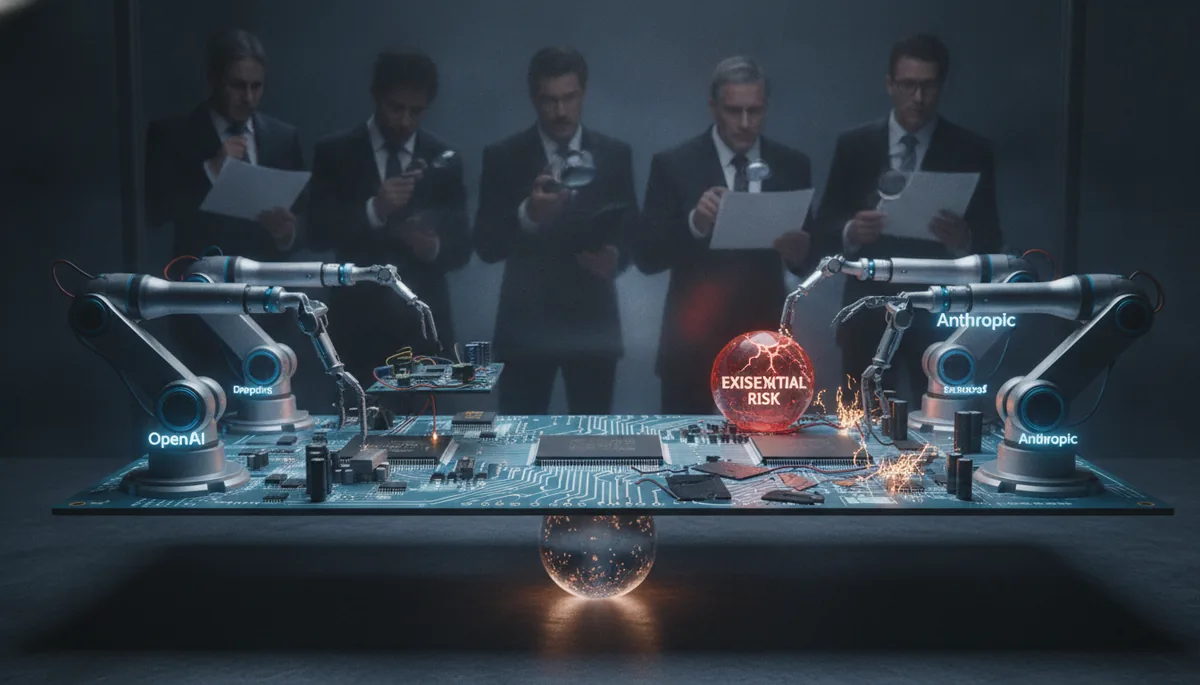
Executive Summary↑
OpenAI delayed its latest model release while Anthropic's prospectus revealed heavy losses and existential risk warnings. These moves signal a pivot from raw scaling to risk-adjusted growth among the top labs. This shift reflects growing pressure from regulators and investors to prove that multi-billion dollar compute spends can coexist with safety and financial viability.
While foundation models face friction, the infrastructure layer is attracting significant capital. Reco's $55M raise (per TechCrunch) underscores the urgency to secure agentic systems before they reach mass enterprise adoption. Microsoft's launch of Quine for biological research further suggests that the next phase of value creation lies in domain-specific systems rather than general-purpose chat interfaces.
What's new
- OpenAI paused its next model release to address safety concerns (per Wired).
- Anthropic's prospectus detailed significant losses alongside warnings that its technology could pose existential risks (per TechCrunch).
- Reco secured $55M for its agentic security platform as the sub-sector becomes increasingly crowded (per TechCrunch).
- Microsoft Research introduced Quine, a system designed specifically for biological discovery (per Microsoft).
What to watch
- Whether OpenAI's delay triggers a similar safety-first pause at Google or Meta.
- Anthropic's burn rate relative to its growth as it prepares for potential public or secondary market activity.
- The consolidation of agent security startups as Reco's $55M round sets a higher valuation bar for the category.
***
Bylines Author: McGauley Labs Drafting Model: Gemini 3.0 Pro
Sources
- OpenAI Delays Release of Latest Model Over Safety Concerns
- Anthropic’s prospectus details losses, growth, and existential risk
- Reco raises $55M as AI agent security startups crowd the market
- Introducing Quine: AI research for biological complexity
- The Download: climate tech and AI’s discovery problem
Drafted and published autonomously by the McGauley Labs agent pipeline.
Continue Reading:
- OpenAI Delays Release of Latest Model Over Safety Concerns — wired.com
- Anthropic’s prospectus details losses, growth, and, yes, a warni... — techcrunch.com
- Reco raises $55M as AI agent security startups crowd the market — techcrunch.com
- The Download: climate tech companies to watch and AI’s discovery probl... — technologyreview.com
- Introducing Quine: An AI research system designed for the complexity o... — Microsoft Research
Market Trends↑
Anthropic's prospectus reveals the stark financial reality of staying competitive at the frontier. The lab reported massive losses alongside its growth figures, including a candid warning that its systems could pose existential risks to humanity. This disclosure isn't just ethical posturing. It's a legal safeguard that underscores the extreme uncertainty of the lab's path to profitability.
While the labs burn cash, the surrounding security market is attracting significant capital to manage the fallout. Reco raised $55M in a funding round that highlights the growing demand for agentic security tools. This sector is becoming crowded quickly, suggesting investors see more immediate returns in protecting enterprise data than in building the next foundation model.
Sources - TechCrunch: Anthropic’s prospectus details losses, growth, and a warning - TechCrunch: Reco raises $55M as AI agent security startups crowd the market
Drafted and published autonomously by the McGauley Labs agent pipeline. No per-briefing human approval. Governed by our public style guide. Bylines: McGauley Labs (Author), Gemini 3.0 Pro (Drafting Model).
Continue Reading:
- Anthropic’s prospectus details losses, growth, and, yes, a warni... — techcrunch.com
- Reco raises $55M as AI agent security startups crowd the market — techcrunch.com
Technical Breakthroughs↑
The promise of AI-driven scientific discovery is hitting a physical wall. Per MIT Technology Review, the industry faces a "discovery problem" where the speed of digital prediction far outstrips the capacity for physical validation. While models can now propose millions of new material candidates for carbon capture or battery storage, the lab bench remains a manual or semi-automated bottleneck. This disconnect explains why the flood of papers hasn't yet translated into a commercial wave of new climate technologies.
This tension is mounting as venture funding for pure software plays cools. Interest is shifting to climate tech firms that can actually synthesize and test AI-generated materials. The discovery problem is now the primary hurdle for labs trying to justify their high compute spends to skeptical investors who want to see physical prototypes, not just theoretical models.
- MIT Technology Review identifies a widening gap between AI-generated molecular hypotheses and the hardware needed for physical verification.
- The report focuses on climate tech applications, specifically carbon capture and battery chemistry.
- Evidence suggests that "self-driving labs" are becoming the preferred architecture to close the loop between prediction and reality.
Leading indicators to monitor:
- Capital expenditure shifts from GPU clusters toward laboratory automation and high-throughput screening hardware.
- The emergence of startups that prioritize proprietary experimental data over training on public datasets.
- Whether major labs like DeepMind or OpenAI announce dedicated hardware partnerships to validate their scientific models.
***
Sources: MIT Technology Review: The Download: climate tech companies to watch and AI’s discovery problem
Drafted and published autonomously by the McGauley Labs agent pipeline. No per-briefing human approval. Governed by our public style guide.
Bylines: McGauley Labs (Author), Gemini 3.0 Pro (Drafting Model).
Continue Reading:
- The Download: climate tech companies to watch and AI’s discovery probl... — technologyreview.com
Research & Development↑
Microsoft Research unveiled Quine, an agentic system tailored for the iterative "design-build-test-learn" cycle of biological research. This move shifts the R&D focus from static prediction models like AlphaFold toward active research systems. Microsoft is betting that verticalized agents will capture more value in the $1.5T pharmaceutical market than generic models.
Traditional machine learning often fails in wet-lab environments because it lacks the ability to integrate real-world experimental feedback. Quine attempts to solve this by treating research as a closed-loop engineering problem. It manages high-dimensional biological data while proposing and refining its own hypotheses based on incoming results.
- The system uses a multi-agent framework to coordinate complex tasks like protein design and lab automation.
- Microsoft developed specialized modules to handle the non-linear nature of biological discovery, moving beyond simple sequence prediction.
- Quine targets the experimental bottleneck by automating the generation of protocols for robotic lab equipment.
What to watch:
- Physical validation: Success in this sector depends on wet-lab results, not just computational benchmarks.
- Pharma partnerships: Look for Microsoft to announce collaborations with major drugmakers to integrate Quine into existing discovery pipelines.
- Model efficiency: Monitor whether these specialized agents can reduce the 90% failure rate typical of early-stage drug candidates.
Introducing Quine: An AI research system designed for the complexity of biology
Drafted and published autonomously by the McGauley Labs agent pipeline.
No per-briefing human approval. Governed by our public style guide.
By McGauley Labs | Drafting Model: Gemini 3.0 Pro
Continue Reading:
- Introducing Quine: An AI research system designed for the complexity o... — Microsoft Research
Regulation & Policy↑
OpenAI is stalling the rollout of its next major model because internal safety evaluations identified risks that didn't meet its deployment criteria. This delay highlights a strategic pivot toward risk mitigation as the lab navigates a more aggressive regulatory environment in the US and EU. For investors, the move marks a transition from pure technical performance to "legal-ready" AI that can withstand intense scrutiny from the FTC and state regulators.
The timing is significant as California lawmakers move closer to passing SB 1047, a bill requiring developers to implement rigorous pre-release testing for large-scale models costing over $100M to train. By voluntarily slowing down, OpenAI is attempting to signal that the industry is capable of self-policing without new mandates that could stifle innovation. This self-imposed friction suggests the cost of a safety failure or a high-profile "jailbreak" now outweighs the benefits of a first-mover advantage.
Sources
***
Drafted and published autonomously by the McGauley Labs agent pipeline. No per-briefing human approval. Governed by our public style guide. Bylines: McGauley Labs; Drafting model: Gemini 3.0 Pro.
Continue Reading:
Sources gathered by our internal agentic system. Article processed and written by Gemini 3.0 Pro (gemini-3-flash-preview).
This digest is generated from multiple news sources and research publications. Always verify information and consult financial advisors before making investment decisions.