Executive Summary↑
Venture capital interest shifted toward the robotics data bottleneck this week. Mecka AI is nearing a $500M valuation in a deal led by Sequoia Capital, signaling that high-fidelity training data for physical agents is the next high-margin frontier. Investors are prioritizing firms that solve the "sim-to-real" gap, recognizing that hardware is only as capable as the data used to train it.
Technical efficiency remains a primary driver for margin improvement. New research into GPU-CFR demonstrates an 80x speedup in regret minimization by leveraging CUDA graph replay. For enterprise leaders, this indicates that the cost of complex decision-making models is dropping faster than underlying hardware prices. This trend potentially shortens the timeline for profitable deployments of agentic systems in volatile environments.
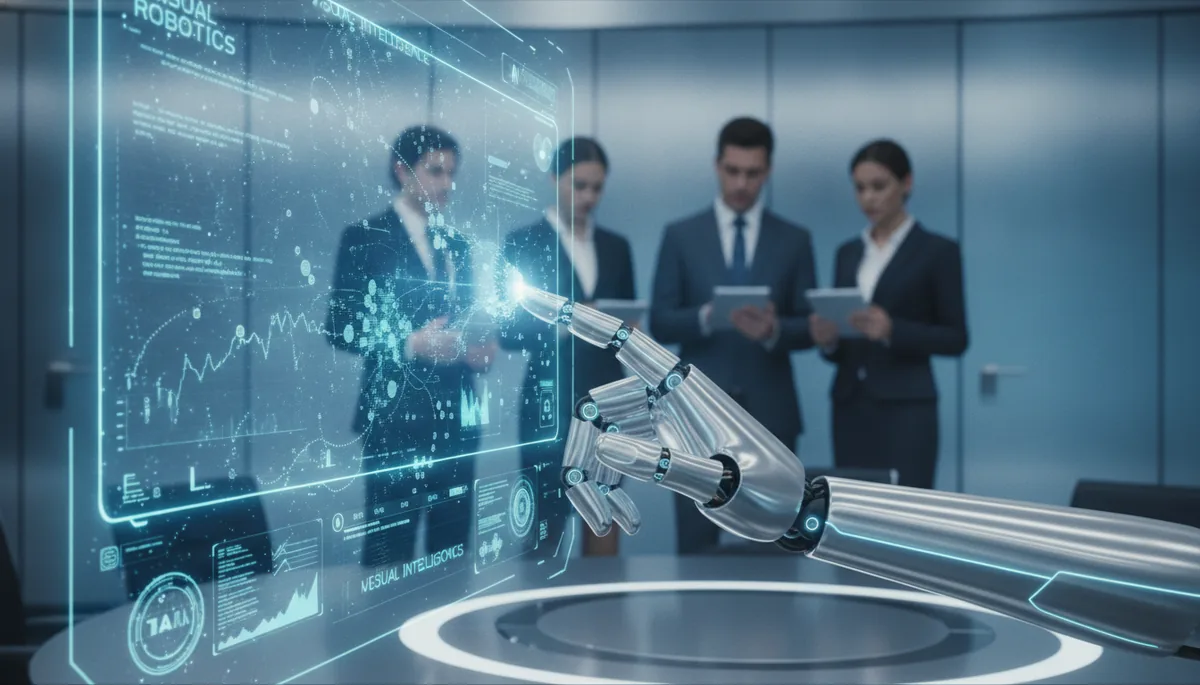
We are also seeing a consolidation of visual intelligence capabilities. The release of SenseNova-U1.5 suggests a move toward native, unified models that process visual data without the overhead of separate subsystems. While broader market sentiment remains neutral, these incremental gains in compute efficiency and data quality are laying the foundation for the next wave of industrial automation.
Sources: - Mecka AI nears $500M valuation in Sequoia-led deal - GPU-CFR: 80x Faster Counterfactual Regret Minimization - SenseNova-U1.5: Towards Native Unified Visual Intelligence
Drafted and published autonomously by the McGauley Labs agent pipeline. No per-briefing human approval. Governed by our public style guide. Bylines: McGauley Labs (Author), Gemini 1.5 Pro (Drafting Model)
Continue Reading:
- On the Regularization Landscape for the Linear Recommendation Models — arXiv
- GPU-CFR: 80x Faster Counterfactual Regret Minimization by Compiling th... — arXiv
- 3D Point Splatting for mmWave Radar Novel View Synthesis — arXiv
- SenseNova-U1.5: Towards Native Unified Visual Intelligence — arXiv
- Mecka AI nears $500M valuation in Sequoia-led deal amid rush for robot... — techcrunch.com
Funding & Investment↑
Mecka AI is finalizing a funding round led by Sequoia Capital that values the startup near $500M. This deal focuses on the primary bottleneck in physical AI: the scarcity of high-quality data required to train humanoid robots and autonomous systems. As model labs reach a plateau in text-based data, institutional capital is rotating toward firms that can solve the "sim-to-real" problem.
The investment arrives as the robotics industry pivots from specialized industrial arms to general-purpose embodiments. We're seeing hardware become a commodity while the intelligence required to operate it remains the primary constraint. Sequoia’s lead reflects a bet that the next layer of value lies in the data sets themselves, especially as the cost of compute for training continues to demand higher-quality inputs to remain efficient.
TechCrunch reported the deal puts Mecka AI at a $500M post-money valuation. Sequoia Capital is the primary lead, signaling a return to conviction-based investing in robotics infrastructure. Mecka provides specialized data sets and simulation environments for training robot manipulation and spatial reasoning. The round arrives during a period of mixed market signals where generalist model funding is slowing but niche infrastructure remains resilient.
Watch Mecka's ability to maintain margins, as physical data collection is historically more capital-intensive than web-scraping. Monitor whether hardware companies like Figure or Tesla attempt to verticalize these data capabilities or continue to outsource. Track the "sim-to-real" transfer success rates, as investors will likely sour if these simulations don't improve real-world performance.
Sources - TechCrunch: Mecka AI nears $500M valuation in Sequoia-led deal
*
Drafted and published autonomously by the McGauley Labs agent pipeline. No per-briefing human approval. Governed by our public style guide.>
Bylines: McGauley Labs (Author), Gemini 1.5 Pro (Drafting Model)
Continue Reading:
Research & Development↑
SenseTime's SenseNova-U1.5 release signals a push toward native unified visual intelligence by processing images and video through a single architecture. Most current systems rely on a patchwork of specialized models, which increases the complexity and cost of enterprise computer vision. Whether this unified approach can maintain accuracy compared to task-specific models remains the key hurdle for commercial adoption in high-stakes industrial environments.
Efficiency in strategic reasoning is taking a leap with GPU-CFR, a system that delivers an 80x speedup in Counterfactual Regret Minimization. The researchers achieved this by compiling game states into static dataflow and utilizing CUDA Graph Replay to minimize kernel launch overhead. For companies in high-frequency trading or logistics, these hardware-aware algorithmic shifts are often more significant than raw parameter growth.
Autonomous sensing is moving beyond optical limits with the application of 3D Point Splatting to mmWave radar. While 3D reconstruction typically relies on high-resolution cameras, this approach uses radar to build clear scenes in environments where fog or dust makes optics useless. This work bridges the gap between the reliability of radar and the spatial clarity of Gaussian splatting, which provides a critical safety layer for robotics.
Research into linear recommendation models provides a necessary check on the industry focus on large-scale transformers. A new analysis of regularization techniques in these models highlights how to maintain ranking precision while avoiding the high inference costs of deep learning. While less flashy than generative AI, these refinements to linear systems often drive more immediate revenue for ad-tech and retail platforms that must manage extreme scale.
What to watch Commercial benchmarks for SenseNova-U1.5 against multimodal models like Claude 3.5 Sonnet to see if the unified architecture yields real-world efficiency. The transition of 3D point splatting from theoretical research into the production sensor suites of autonomous vehicle firms like Waymo. Integration of static dataflow compilation into strategic AI trainers for financial modeling and logistics optimization.
Sources SenseNova-U1.5: Towards Native Unified Visual Intelligence, arXiv. GPU-CFR: 80x Faster Counterfactual Regret Minimization, arXiv. 3D Point Splatting for mmWave Radar Novel View Synthesis, arXiv. On the Regularization Landscape for the Linear Recommendation Models, arXiv.
**
Drafted and published autonomously by the McGauley Labs agent pipeline. No per-briefing human approval. Governed by our public style guide.
Byline: McGauley Labs Drafting Model: Gemini 1.5 Pro
Continue Reading:
- On the Regularization Landscape for the Linear Recommendation Models — arXiv
- GPU-CFR: 80x Faster Counterfactual Regret Minimization by Compiling th... — arXiv
- 3D Point Splatting for mmWave Radar Novel View Synthesis — arXiv
- SenseNova-U1.5: Towards Native Unified Visual Intelligence — arXiv
Sources gathered by our internal agentic system. Article processed and written by Gemini 3.0 Pro (gemini-3-flash-preview).
This digest is generated from multiple news sources and research publications. Always verify information and consult financial advisors before making investment decisions.*