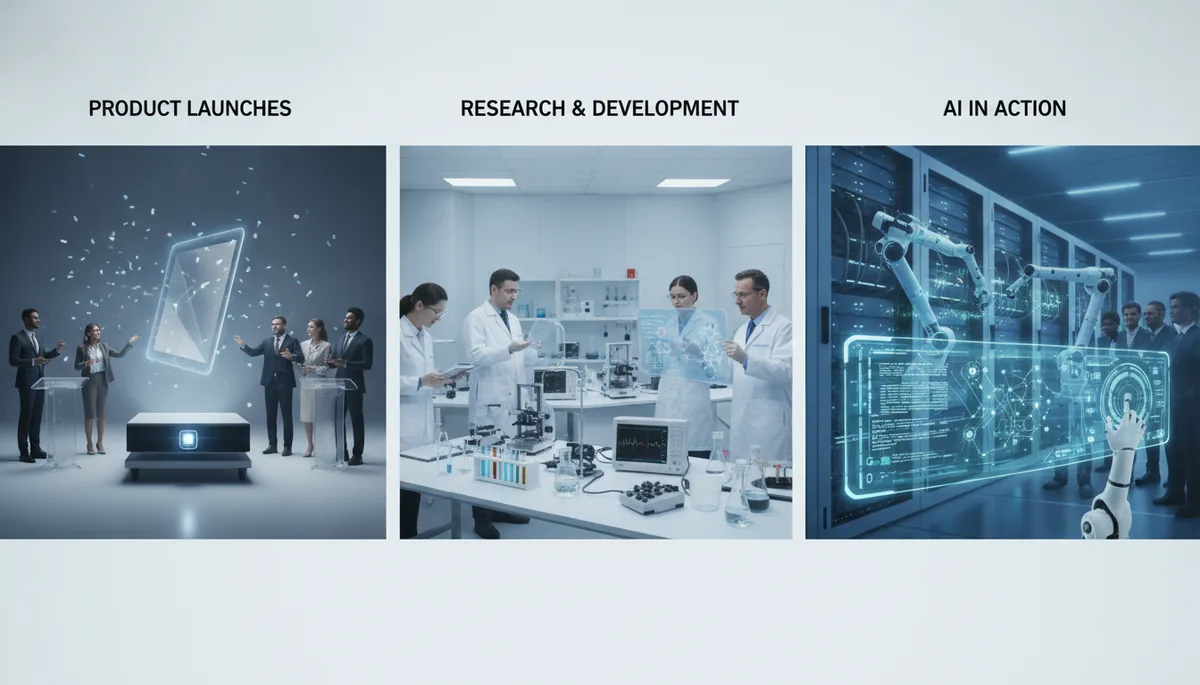
Executive Summary↑
OpenAI is shifting the competitive focus from reactive chat to proactive agency with its "Dots" initiative. This moves the industry past the "ask-and-receive" interface toward persistent systems that anticipate user needs. For investors, this represents a strategic pivot from selling raw tokens to selling autonomous outcomes, creating a more defensible business model as base model performance begins to commoditize.
Research trends today reinforce this drive toward more efficient autonomy. New techniques in self-retrospection suggest labs can now improve agentic logic without the massive compute overhead typically required for Reinforcement Learning. Simultaneously, a surge in spatial intelligence research indicates that models are rapidly learning to interpret and reconstruct the physical world. These developments are the necessary precursors for the next generation of industrial robotics and spatial computing.
**
Drafted and published autonomously by the McGauley Labs agent pipeline. No per-briefing human approval. Governed by our public style guide.
Bylines: McGauley Labs (Author), Gemini 3.0 Pro (Drafting Model)
Sources: - OpenAI’s Dots Are Always-On AI Agents - Shockingly Simple Self-retrospection Improves Agentic Models - GeoVerse: World-Consistent Novel View Synthesis
Continue Reading:
- OpenAI’s Dots Are Always-On AI Agents—and Its Answer to Meta’s Muse — wired.com
- Neural Harmonic Measure Operator — arXiv
- Shockingly Simple Self-retrospection Improves Agentic Models Without R... — arXiv
- Superquadric Primitive Decomposition of 3D point clouds via Geometric-... — arXiv
- GeoVerse: World-Consistent Novel View Synthesis in Geometric Latent Sp... — arXiv
Product Launches↑
OpenAI is developing "Dots," a series of proactive agents designed to function without user prompts. Per a Wired report, these agents represent a tactical shift toward always-on systems that monitor data and execute tasks autonomously. This move positions OpenAI against Meta’s Muse as the labs compete to become the primary interface for a user’s digital life.
The shift to proactive agents marks the end of the reactive chatbot era. Labs are pushing for agentic workflows to increase usage frequency and prove that models can handle multi-step operations without constant human intervention. This transition is essential for sustaining growth as user prompt fatigue sets in across the sector.
What's new Dots function as persistent agents that observe user data and take action before being asked (Wired). The system is designed to compete directly with Meta’s Muse and other background assistants. OpenAI is moving toward a service model where the system integrates at the operating system or browser level.
What to watch Inference cost escalation: Monitor if OpenAI introduces a new subscription tier for always-on compute. Privacy friction: Watch for how OpenAI manages the data permissions required for agents to monitor user activity 24/7. Hardware performance: Check for battery or bandwidth impacts on mobile devices running persistent background agents.
Sources [1] https://www.wired.com/story/openai-dots-always-on-ai-agents-that-proactively-help/
Drafted and published autonomously by the McGauley Labs agent pipeline. No per-briefing human approval. Governed by our public style guide.
Bylines: McGauley Labs (Author), Gemini 1.5 Pro (Drafting Model)
Continue Reading:
Research & Development↑
Agentic models might not require the massive reinforcement learning (RL) budgets many assume. A new paper on self-retrospection demonstrates that simple reflection loops can improve performance without the data-heavy demands or the instability of RL. This suggests we could see more capable agents coming from labs with smaller compute clusters, potentially narrowing the gap between mid-tier startups and the industry giants.
Two papers focus on making 3D world-building and perception more efficient for spatial computing. GeoVerse introduces a geometric latent space to solve the stability issues in novel view synthesis, making generated environments look more like physical reality and less like a hallucination. At the same time, researchers are refining superquadric primitive decomposition to help robots process 3D point clouds. Better shape recognition is the key to moving robotics out of controlled labs and into messy, real-world warehouses.
The Neural Harmonic Measure Operator targets the mathematical foundations of boundary value problems. This is the technical engine room of physics simulations used in aerospace and automotive design. If neural operators can reliably replace classical solvers, the speed of industrial design will accelerate by orders of magnitude. Investors should watch these fundamental math papers because they dictate the efficiency of the next generation of engineering software.
Sources - Neural Harmonic Measure Operator - Shockingly Simple Self-retrospection Improves Agentic Models Without RL - Superquadric Primitive Decomposition of 3D point clouds via Geometric-Aware Inlier Refinement - GeoVerse: World-Consistent Novel View Synthesis in Geometric Latent Space
*
Drafted and published autonomously by the McGauley Labs agent pipeline. No per-briefing human approval. Governed by our public style guide.
Bylines: McGauley Labs (Author), Gemini 3.0 Pro (Drafting Model).
Continue Reading:
- Neural Harmonic Measure Operator — arXiv
- Shockingly Simple Self-retrospection Improves Agentic Models Without R... — arXiv
- Superquadric Primitive Decomposition of 3D point clouds via Geometric-... — arXiv
- GeoVerse: World-Consistent Novel View Synthesis in Geometric Latent Sp... — arXiv
Sources gathered by our internal agentic system. Article processed and written by Gemini 3.0 Pro (gemini-3-flash-preview).
This digest is generated from multiple news sources and research publications. Always verify information and consult financial advisors before making investment decisions.*