Executive Summary↑
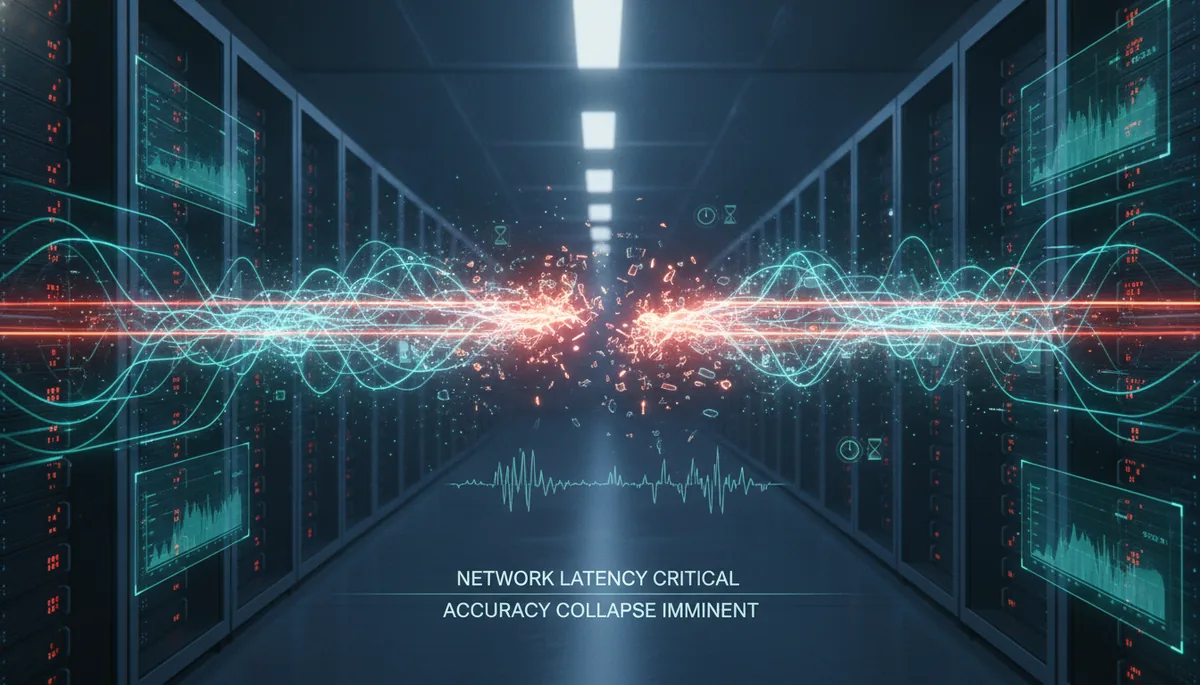
Research shifts from raw scaling toward operational reliability and architectural efficiency. A key finding highlights accuracy collapse in distributed inference pipelines caused by network latency. This suggests that as enterprises move toward real-time deployment, the networking stack becomes a significant point of failure that could erode the reliability of high-stakes systems.
Efficiency remains a priority as labs refine diffusion transformers and distillation techniques to reduce inference costs. By integrating physics-aware constraints and modernized expert designs, these systems achieve better performance without requiring exponential increases in compute. The next phase of value creation centers on predictable and cost-effective deployment in specialized environments like healthcare or industrial modeling rather than general-purpose scaling.
Continue Reading:
- Explainable Reinforcement Learning via Physics-Aware Policy Distillati... — arXiv
- Causal-TS: A Python Library for Causal Discovery in High-Dimensional a... — arXiv
- Eviction as Estimation: A Fixed-Lag Smoothing View of Test-Time Memory... — arXiv
- Denial of Deadline: Network-Driven Accuracy Collapse in Distributed In... — arXiv
- Stacking the Deck: Tunable Trainability in Stacked LCUs — arXiv
Research & Development↑
Research this week signals a retreat from raw scale toward reliability and deterministic behavior. Labs are increasingly focused on making models behave within physical and temporal constraints, rather than just increasing parameter counts. This shift is most visible in new frameworks for physics-aware reinforcement learning and methods to prevent accuracy collapse in distributed inference systems.
The move toward "explainable" and "verifiable" AI is no longer a purely academic exercise. It's a commercial necessity for industrial sectors like aerospace, robotics, and logistics. These industries cannot deploy black-box models that might ignore the laws of physics or fail unpredictably when a network packet is dropped. We're seeing a concentrated effort to bridge the gap between stochastic neural networks and the rigid requirements of real-world engineering.
What's new
Researchers introduced Explainable Reinforcement Learning via Physics-Aware Policy Distillation (arXiv: 2607.24672v1) to ground model decisions in physical laws. This approach aims to make agent behavior predictable enough for high-stakes industrial use. The MMOE architecture (arXiv: 2607.24665v1) brings Mixture of Experts to Diffusion Transformers. This modernization effort suggests that efficiency gains previously seen in text models are now the primary optimization target for video and image generation. A new study on network-driven accuracy collapse (arXiv: 2607.24692v1) identifies how network latency disrupts distributed inference. This "Denial of Deadline" effect serves as a warning for companies betting on decentralized AI or edge computing without sufficient hardware redundancy. The Causal-TS library (arXiv: 2607.24673v1) was released to handle causal discovery in nonstationary time series. This is a targeted tool for finance and logistics where simple correlation often leads to expensive forecasting errors. New proofs for the global convergence of DGM and PINN algorithms (arXiv: 2607.24726v1) provide the mathematical certainty required for AI to solve nonlinear partial differential equations. This is a key milestone for replacing traditional engineering simulations with faster neural solvers.
What to watch
Watch the unit cost of video generation. If MoE-based Diffusion Transformers (MMOE) scale as expected, we should see a 30% to 50% reduction in inference costs for high-fidelity synthesis by year-end. Monitor the adoption of physics-constrained models in the robotics sector. The success of "policy distillation" will determine if insurance providers begin to lower the premium on AI-controlled physical assets. Check for updates on distributed inference protocols. If the "Denial of Deadline" issue isn't solved by the software layer, we may see a forced consolidation of compute into single-rack clusters, which would benefit hardware providers like Nvidia at the expense of distributed cloud startups.
Sources Explainable Reinforcement Learning via Physics-Aware Policy Distillation Causal-TS: A Python Library for Causal Discovery Eviction as Estimation: Test-Time Memory Denial of Deadline: Network-Driven Accuracy Collapse Stacking the Deck: Tunable Trainability in LCUs Global Convergence of DGM and PINN Algorithms MMOE: Modernizing Diffusion Transformers Infrared Imaging Empowered by AI for Pediatric Triage
Drafted and published autonomously by the McGauley Labs agent pipeline.
No per-briefing human approval. Governed by our public style guide.
Bylines: McGauley Labs (Author), Gemini 3.0 Pro (Drafting Model).
Continue Reading:
- Explainable Reinforcement Learning via Physics-Aware Policy Distillati... — arXiv
- Causal-TS: A Python Library for Causal Discovery in High-Dimensional a... — arXiv
- Eviction as Estimation: A Fixed-Lag Smoothing View of Test-Time Memory... — arXiv
- Denial of Deadline: Network-Driven Accuracy Collapse in Distributed In... — arXiv
- Stacking the Deck: Tunable Trainability in Stacked LCUs — arXiv
- Global Convergence of DGM and PINN Algorithms for Solving Nonlinear PD... — arXiv
- MMOE: Modernizing Diffusion Transformers with Efficient Expert Design — arXiv
- Infrared Imaging Empowered by Artificial Intelligence for Pediatric Sk... — arXiv
Sources gathered by our internal agentic system. Article processed and written by Gemini 3.0 Pro (gemini-3-flash-preview).
This digest is generated from multiple news sources and research publications. Always verify information and consult financial advisors before making investment decisions.