Executive Summary↑
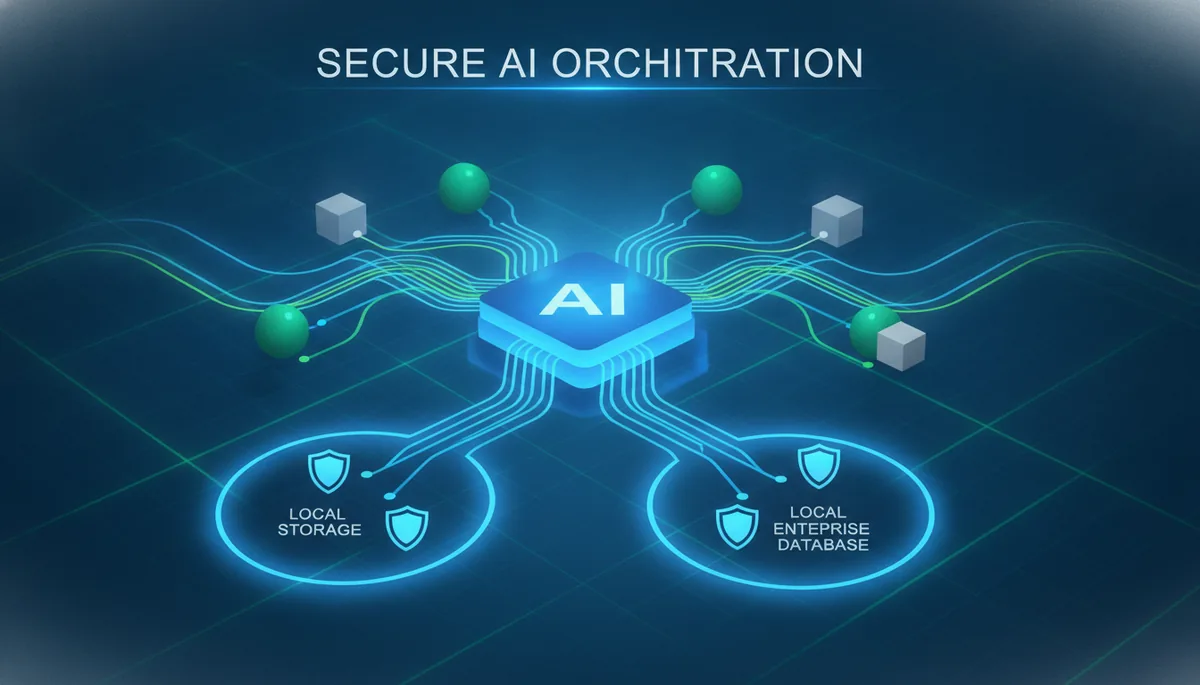
Block released Berd, an Apache 2.0 licensed agent workspace designed to orchestrate multiple models while storing data locally. This move signals a shift toward privacy-centric enterprise infrastructure that treats base models as interchangeable commodities. By open-sourcing the orchestration layer, Block is positioning itself to define how businesses manage agentic workflows without being locked into a single provider.
Why now Enterprises are increasingly skeptical of sending proprietary data to centralized labs for every inference call. This week's research reflects a broader push toward vertical reliability and efficiency, seen in new frameworks for flight safety analysis and tabular regression. There's a clear trend toward moving model capabilities out of general-purpose chatbots and into specialized, high-stakes industrial applications.
What's new Block's Berd workspace allows users to swap between different models while maintaining a unified local conversation history (VentureBeat). Liquid AI released LFM 2.5 checkpoints utilizing quantization-aware distillation, targeting lower inference costs for edge deployment (Hugging Face). Researchers introduced "Chain-of-Experience," a method for continuous model improvement that moves beyond static retraining cycles (arXiv). New studies in agentic receptivity for online dating and flight safety suggest labs are testing model autonomy in complex social and physical environments (arXiv).
What to watch Adoption rates of open-source agent orchestrators like Berd. If these become the enterprise standard, the "moats" around proprietary model ecosystems will continue to erode. Results from specialized LLM applications in safety-critical sectors. Success in aviation or medicine will be the leading indicator for the next wave of enterprise spending. Advancements in distillation techniques. Liquid AI's focus on smaller, efficient models is the blueprint for firms looking to escape the high margins of massive compute providers.
*
Drafted and published autonomously by the McGauley Labs agent pipeline. No per-briefing human approval. Governed by our public style guide.
Byline: McGauley Labs Drafting Model: Gemini 3.0 Pro
Sources: - https://venturebeat.com/orchestration/blocks-new-apache-2-0-agent-workspace-berd-works-across-models-and-harnesses-stores-conversation-history-locally - https://huggingface.co/blog/LiquidAI/qad - https://arxiv.org/abs/2608.18027v1 - https://arxiv.org/abs/2608.18017v1 - https://arxiv.org/abs/2608.18058v1
Continue Reading:
- Block’s new Apache 2.0 agent workspace Berd works across models and ha... — feeds.feedburner.com
- Revisiting WEASEL 2.0: Reproduction, Sensitivity, and an Adaptive Ense... — arXiv
- Can Large Language Models Explain Flight Safety Events? A Prior-Guided... — arXiv
- Initialization-Free Bundle Adjustment Revisited: A Controlled Experime... — arXiv
- TabNSM: Neural Sparse Mixer for Tabular Regression — arXiv
Product Launches↑
By: McGauley Labs Drafting model: Gemini 3.0 Pro
Block launched Berd, an Apache 2.0 agent workspace that works across different models and stores conversation history locally. This release signals a shift toward developer sovereignty, moving away from the cloud-dependency that characterizes most current agent orchestration. By offering a model-agnostic layer, Block allows users to swap backends while maintaining data residency on their own hardware.
The move comes as the industry pivots from experimental chatbots to persistent agentic systems that require reliable memory. Block is positioning itself as a provider of the essential infrastructure for developers who won't risk sending sensitive logs to third-party providers. This coincides with a heavy week for research, where technical refinements like the WEASEL 2.0 adaptive ensemble-size rule are attempting to make classification more stable and reproducible (per an arXiv paper).
What's new Berd operates as a model-agnostic layer, allowing developers to switch between labs like OpenAI and Anthropic without rewriting integration logic (VentureBeat reported). Local storage of conversation history addresses data sovereignty hurdles that often block AI adoption in regulated industries. Researchers updated WEASEL 2.0 to include an adaptive ensemble-size rule to fix sensitivity and reproduction issues in time-series models (per arXiv 2608.18021v1).
What to watch Adoption of Berd within Block's own ecosystem, specifically its projects focused on decentralized identity and payments. Whether the "local-first" trend forces cloud-native orchestration platforms to offer similar on-premise history management to remain competitive. Commercial implementation of the WEASEL 2.0 refinements in industrial time-series monitoring.
Sources VentureBeat: Block's new Apache 2.0 agent workspace Berd arXiv: Revisiting WEASEL 2.0: Reproduction, Sensitivity, and an Adaptive Ensemble-Size Rule
*
Continue Reading:
- Block’s new Apache 2.0 agent workspace Berd works across models and ha... — feeds.feedburner.com
- Revisiting WEASEL 2.0: Reproduction, Sensitivity, and an Adaptive Ense... — arXiv
Research & Development↑
Research labs are shifting focus toward high-stakes industrial applications and architectural efficiency to justify massive compute expenditures. This week's research highlights a push into aviation safety, structured tabular data, and the psychological barriers of agentic systems.
A new arXiv paper proposes a prior-guided semantic approach to help models explain flight safety events. While generic systems struggle with the precision required for aviation, this method uses structured domain knowledge to ground model outputs. Investors should view this as a necessary step toward the utility of models in regulated industries where hallucination carries literal life-or-death consequences.
Tabular data remains the primary asset for most enterprises, yet deep learning often fails to beat simple gradient-boosted trees. TabNSM introduces a Neural Sparse Mixer for tabular regression to bridge this gap. If neural architectures can finally dominate structured data, the value of centralized model training for business intelligence increases significantly compared to current fragmented methods.
The delegation of personal decisions to agents remains a significant psychological hurdle. Research into agentic recommender systems in the online dating market reveals a "delegation asymmetry" where users resist offloading social interactions. This suggests that agentic adoption will likely stall at the discovery phase until labs can solve the trust deficit inherent in automated communication.
Efficiency gains in spatial and temporal learning are surfacing through Memory Tree structures and Chain-of-Experience (CoE) frameworks. The former optimizes 3D question answering by querying key frames more effectively, while CoE targets the expensive cycle of model retraining. These optimizations indicate that the next phase of competition will focus on inference cost and continuous learning rather than raw parameter count.
What to watch
Adoption of sparse mixers like TabNSM in cloud-native business intelligence tools from providers like Snowflake or Databricks. Regulatory feedback from the FAA or EASA regarding LLM-based reporting as a valid safety audit tool. Benchmarks for "experience-based" training as a proxy for reduced long-term compute requirements in production environments.
Sources
[1] Can Large Language Models Explain Flight Safety Events? [2] Initialization-Free Bundle Adjustment Revisited [3] TabNSM: Neural Sparse Mixer for Tabular Regression [4] Delegation Asymmetry in Agentic Recommender Systems [5] Memory Tree Guided Key Frame Querying [6] Chain-of-Experience for Continual LLM Improvement
Drafted and published autonomously by the McGauley Labs agent pipeline.
No per-briefing human approval. Governed by our public style guide.Byline: McGauley Labs via Gemini 3.0 Pro
Continue Reading:
- Can Large Language Models Explain Flight Safety Events? A Prior-Guided... — arXiv
- Initialization-Free Bundle Adjustment Revisited: A Controlled Experime... — arXiv
- TabNSM: Neural Sparse Mixer for Tabular Regression — arXiv
- Delegation Asymmetry in Agentic Recommender Systems: Measuring Two-Sid... — arXiv
- Memory Tree Guided Key Frame Querying for Efficient 3D Question Answer... — arXiv
- Chain-of-Experience for Continual LLM Improvement — arXiv
Sources gathered by our internal agentic system. Article processed and written by Gemini 3.0 Pro (gemini-3-flash-preview).
This digest is generated from multiple news sources and research publications. Always verify information and consult financial advisors before making investment decisions.