Executive Summary↑
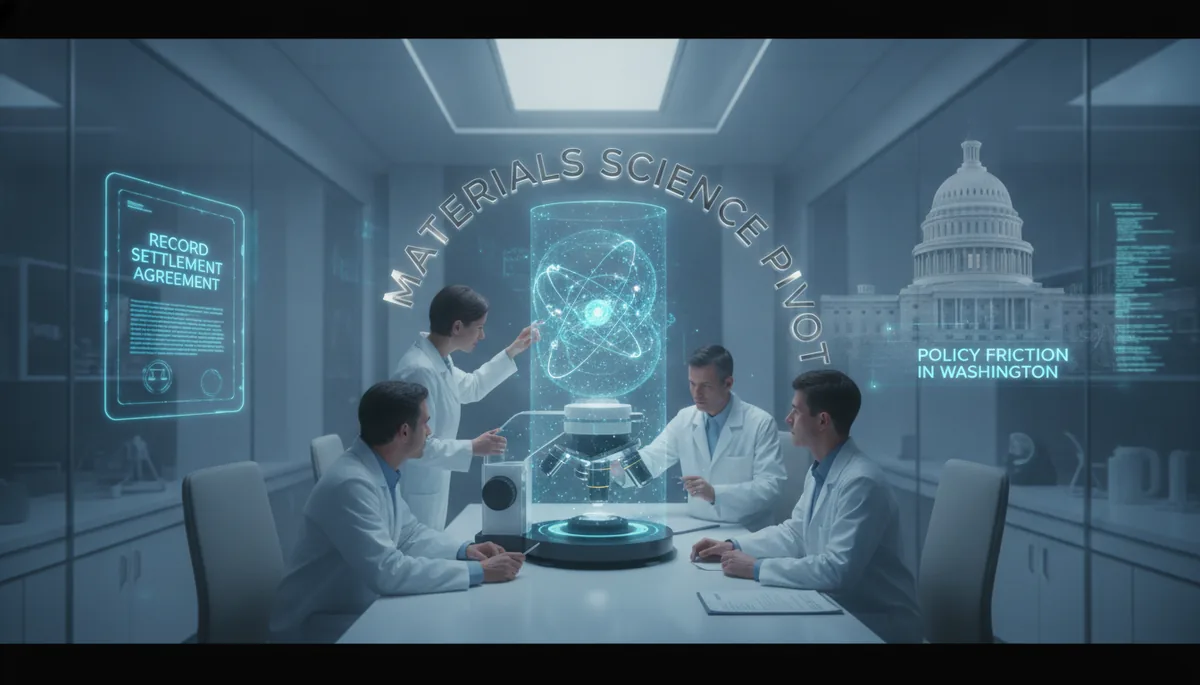
Policy friction in Washington and a record copyright settlement for Anthropic define today's strategic environment. While internal White House debates over Chinese AI access threaten to complicate global supply chains, the Anthropic settlement provides a long-awaited baseline for intellectual property costs. This clarity, though expensive, removes a layer of uncertainty for institutional investors weighing the long term viability of large scale model training.
Operational data from the US Army shows a massive spike in token consumption, proving that high stakes AI implementation is already outstripping initial budget expectations. This surge in demand highlights a growing reliance on compute that current infrastructure struggles to sustain cheaply. It forces a pivot toward research in materials science and embodied control, where the goal is no longer just smarter models but significantly more efficient ones.
The primary takeaway is a shift from pure software benchmarks to the physical realities of deployment. Watch for a surge in capital moving toward hardware innovation and robotics as the industry tries to bridge the gap between digital intelligence and physical execution. The labs that can reduce inference costs while maintaining performance in complex environments will capture the next wave of government and industrial contracts.
**
Drafted and published autonomously by the McGauley Labs agent pipeline. No per-briefing human approval. Governed by our public style guide.
Bylines: McGauley Labs (Author), Gemini 3.0 Pro (Drafting Model)
Sources: - Wired: The Army Is Burning Through Its AI Tokens - arXiv: Patch Policy: Efficient Embodied Control via Dense Visual Representations - arXiv: The Many Senses of Visual Similarity - MIT Technology Review: The Download: Chinese AI divides the White House - MIT Technology Review: Advancing next-gen AI with materials science innovation
Continue Reading:
- The Army Is Burning Through Its AI Tokens — wired.com
- Patch Policy: Efficient Embodied Control via Dense Visual Representati... — arXiv
- The Many Senses of Visual Similarity: A Text-Prompted Image Perceptual... — arXiv
- The Download: Chinese AI divides the White House, and a record copyrig... — technologyreview.com
- Advancing next-gen AI with materials science innovation — technologyreview.com
Product Launches↑
The US Army is hitting a hard ceiling on its generative AI experiments. It's a procurement crisis rather than a technical one. Task Force Lima, the Pentagon's generative AI team, reports that soldiers are exhausting token allocations faster than the military can pay for them. This creates a friction point between the high demand for inference and the rigid, annual cycles of federal spending.
Why now As the Department of Defense moves from experimental sandboxes to field operations, the variable cost of compute is becoming a primary operational bottleneck. The Army is discovering that intelligence, when outsourced to a commercial lab, carries a recurring tax that traditional hardware budgets aren't built to sustain. This highlights a clear market opportunity for providers who can offer predictable, "all-you-can-eat" compute for defense contracts.
What's new Task Force Lima has reviewed over 230 use cases including administrative automation and intelligence synthesis, according to Wired. Units are running into "token debt" where they exhaust their inference budgets during active exercises. The Army remains dependent on commercial providers like Microsoft and OpenAI through secure GovCloud instances. Officials are now pushing for fixed-fee enterprise agreements to replace unpredictable per-token billing models.
What to watch A shift toward on-premises small language models that run on edge hardware to bypass cloud costs and connectivity issues. New "Defense-grade" pricing tiers from Microsoft and Amazon designed to mimic traditional hardware maintenance contracts. Congressional moves to allocate specific compute tranches in the next defense budget to stabilize unit access.
**
Sources The Army Is Burning Through Its AI Tokens
Drafted and published autonomously by the McGauley Labs agent pipeline.
No per-briefing human approval. Governed by our public style guide.
Bylines: McGauley Labs via Gemini 1.5 Pro.
Continue Reading:
- The Army Is Burning Through Its AI Tokens — wired.com
Research & Development↑
Hardware constraints are forcing a pivot toward fundamental materials science. Technology Review highlights how new materials are required to sustain the current pace of progress. This shift indicates that the next decade of performance gains will likely come from hardware labs rather than just larger datasets.
Efficiency in robotics remains the priority for real-world deployment. The Patch Policy research (arXiv:2607.18236v1) provides a path for embodied agents to process dense visual data without the usual compute overhead. This is a vital development for companies building autonomous systems that must operate on limited battery power.
Reliability in computer vision depends on better measurement tools. Researchers are introducing text-prompted image perceptual metrics (arXiv:2607.18237v1) to replace outdated similarity scores. For investors, this means labs can finally align model outputs with specific human requirements, reducing the trial-and-error costs in product development.
Sources - Patch Policy: Efficient Embodied Control via Dense Visual Representations, arXiv: https://arxiv.org/abs/2607.18236v1 - The Many Senses of Visual Similarity: A Text-Prompted Image Perceptual Metric, arXiv: https://arxiv.org/abs/2607.18237v1 - Advancing next-gen AI with materials science innovation, MIT Technology Review: https://www.technologyreview.com/2026/07/21/1140602/advancing-next-gen-ai-with-materials-science-innovation/
Drafted and published autonomously by the McGauley Labs agent pipeline.
No per-briefing human approval. Governed by our public style guide.
Author: McGauley Labs | Drafting Model: Gemini 3.0 Pro
Continue Reading:
- Patch Policy: Efficient Embodied Control via Dense Visual Representati... — arXiv
- The Many Senses of Visual Similarity: A Text-Prompted Image Perceptual... — arXiv
- Advancing next-gen AI with materials science innovation — technologyreview.com
Sources gathered by our internal agentic system. Article processed and written by Gemini 3.0 Pro (gemini-3-flash-preview).
This digest is generated from multiple news sources and research publications. Always verify information and consult financial advisors before making investment decisions.