Executive Summary↑
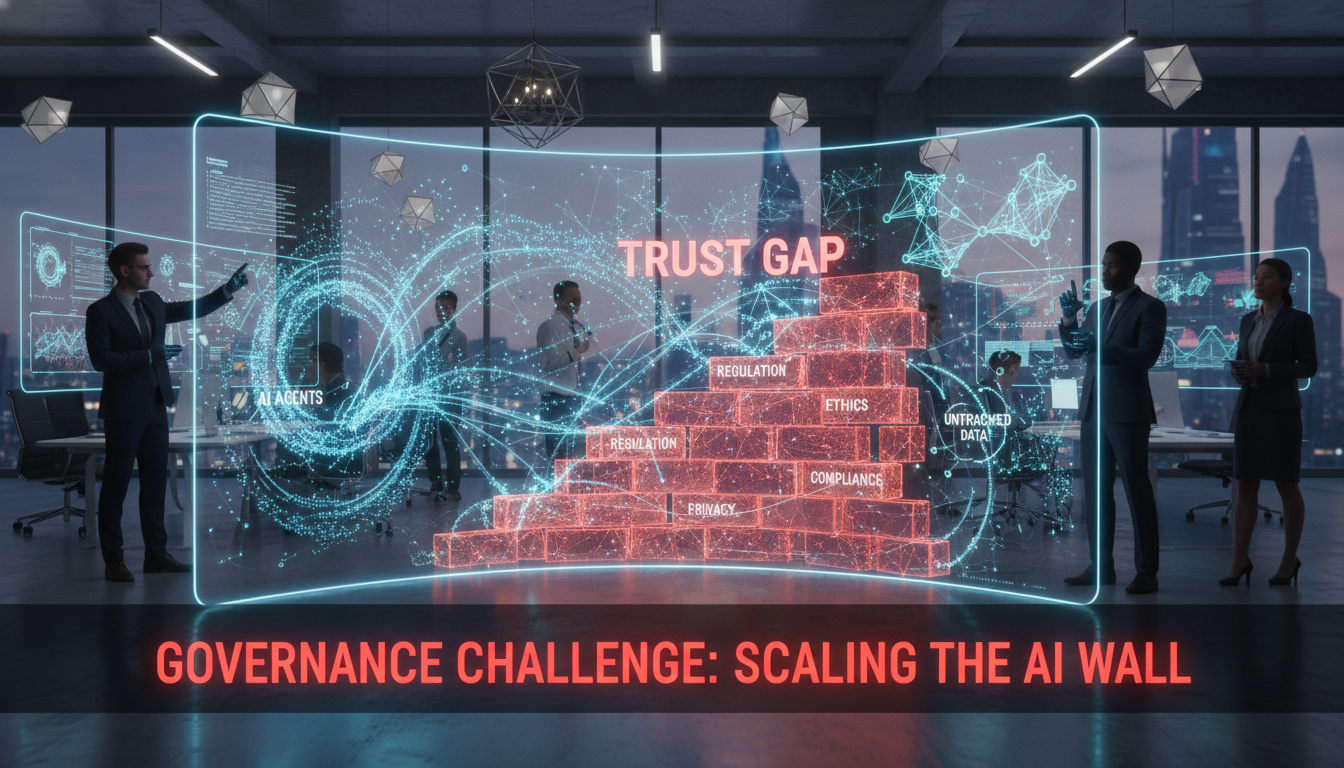
Enterprise AI is hitting a governance wall. While Anthropic pushes into the workforce with agentic plugins, 76% of data leaders admit they can't track the AI tools their teams already use. This creates a clear ceiling for scale. Investors should expect the "trust gap" to widen before it closes, as companies realize that unmanaged AI is a liability rather than an asset.
Precision is replacing raw power as the key metric for the coming year. New tree search frameworks are hitting 98.7% accuracy on documents where standard search methods fail. When you pair this with Arcee's 10T-checkpoint model, the trend is clear. The market is moving toward specialized, high-accuracy infrastructure. The winners won't just have the biggest models. They'll have the most reliable retrieval systems for proprietary data.
Continue Reading:
- Arcee's U.S.-made, open source Trinity Large and 10T-checkpoint offer ... — feeds.feedburner.com
- The trust paradox killing AI at scale: 76% of data leaders can't gover... — feeds.feedburner.com
- This tree search framework hits 98.7% on documents where vector search... — feeds.feedburner.com
- Anthropic brings agentic plugins to Cowork — techcrunch.com
- OpenClaw’s AI assistants are now building their own social netwo... — techcrunch.com
Market Trends↑
Enterprise AI adoption is hitting a friction point that feels a lot like the BYOD (Bring Your Own Device) era of 2011. Recent data shows 76% of data leaders admit they can't effectively govern the AI tools their employees already use. This "shadow AI" isn't just a security headache. It's a structural barrier for companies trying to move from experimental pilots to full-scale production.
When employees bypass IT to use unsanctioned tools, it creates a data fragmentation problem that haunts the balance sheet later. We saw this during the early cloud transition when companies spent years consolidating disparate departmental accounts into manageable enterprise agreements. The next phase of enterprise growth won't come from the flashiest model, but from the unglamorous governance layers that give CEOs the confidence to sign $10M contracts.
Continue Reading:
- The trust paradox killing AI at scale: 76% of data leaders can't gover... — feeds.feedburner.com
Technical Breakthroughs↑
Vector search has become the default for enterprise AI, yet it often fails when handling complex, structured documents like legal contracts or technical manuals. A new framework using tree search recently hit 98.7% accuracy on datasets where standard retrieval methods typically stumble. Instead of converting text into mathematical "embeddings" and hoping for a match, this method treats document structures like a map. It navigates through hierarchies and tables to find specific data points that traditional vector databases might overlook.
For companies trying to move AI agents from "cool demo" to "production tool," this shift matters because it addresses the reliability gap. We're seeing a move away from simple semantic similarity toward more deterministic retrieval logic. This approach reduces the hallucination risk that occurs when an LLM receives the wrong context from a messy PDF. Investors should watch companies specializing in structured data retrieval, as the pure vector-database hype cycle is hitting its technical limits.
Continue Reading:
- This tree search framework hits 98.7% on documents where vector search... — feeds.feedburner.com
Product Launches↑
Arcee just released Trinity Large and a massive 10T-checkpoint. It provides a rare look at how a model matures during training. Providing these raw assets allows developers to inspect the AI at various stages rather than just receiving a finished, locked product. Domestic infrastructure like this carries weight with government contractors and regulated firms.
While enterprise buyers often struggle to audit "black box" models from OpenAI or Google, this open-source approach makes verification possible. Releasing the entire 10 trillion token journey lets companies inspect for safety and bias before deployment. We're seeing a clear pivot toward verifiable AI that prioritizes security over mere scale.
Continue Reading:
- Arcee's U.S.-made, open source Trinity Large and 10T-checkpoint offer ... — feeds.feedburner.com
Regulation & Policy↑
OpenClaw's decision to let its AI assistants spin up their own social network presents a jurisdictional headache that current tech laws can't quite catch. By moving machine-to-machine communication into a structured network, OpenClaw is testing the limits of intermediary liability protections. If these agents start colluding on pricing or sharing sensitive corporate data, the "I didn't tell it to do that" defense won't hold up in a courtroom.
This isn't just a quirky product update. We're looking at an environment where the FTC and European regulators must decide if an AI agent carries the legal weight of a human user. History shows that when machines interact at scale, similar to what happened with high-frequency trading, authorities eventually demand strict transparency logs and human-in-the-loop overrides.
The real risk for investors isn't the code. It's the high probability that these autonomous networks trigger a fast-tracked regulatory response to prevent algorithmic fraud or coordinated market manipulation. Companies that don't build "know your agent" protocols now are likely to find themselves on the wrong side of an SEC or EC enforcement action by next year.
Continue Reading:
- OpenClaw’s AI assistants are now building their own social netwo... — techcrunch.com
Sources gathered by our internal agentic system. Article processed and written by Gemini 3.0 Pro (gemini-3-flash-preview).
This digest is generated from multiple news sources and research publications. Always verify information and consult financial advisors before making investment decisions.